Hybrid Office Rollout Example That Works

A hybrid office rollout example only becomes useful when it shows what changes on Monday morning - not just what appears on a slide deck. For most organisations, the real test is simple: can people arrive, find the right setting for the work ahead, and get comfortable in minutes without clutter, confusion or compromise?
That is where many hybrid strategies stall. The policy may be clear, the floor plan may look convincing, and the leadership narrative may be settled. Yet daily use tells a different story. Shared desks fill up unevenly. Personal equipment spreads across the office. Storage becomes improvised. People spend the first ten minutes of the day rebuilding a workstation from scratch.
A stronger rollout starts with a more practical brief. Hybrid working is not only about where people work. It is about how quickly they can set up, how consistently they can work across settings, and how well the office supports movement between focus, collaboration and short-term touchdown use. The best rollouts treat these details as part of the workplace strategy, not as afterthoughts.
A practical hybrid office rollout example
Imagine a 350-person professional services firm moving from assigned desks to a hybrid model across one main office and a smaller regional site. The goal is not to reduce the office to a booking system and a clean desk memo. It is to create a calmer, more functional environment that supports desk sharing, protects the employee experience and makes better use of space.
Before the rollout, the office had one desk type, one storage logic and one daily behaviour: arrive, claim a workstation and leave personal items in place. That model worked when attendance was predictable and desks were fixed. It breaks quickly once people move between home, project rooms, client sites and shared neighbourhoods.
The workplace team begins by mapping actual work patterns rather than idealised ones. They identify four common modes: focused individual work, planned team collaboration, short stay touchdown use and project-based co-working. This matters because a hybrid office should not force every task into the same setting. If it does, friction rises and the office feels busy without feeling effective.
The next step is a pilot floor rather than a whole-building change. Around 60 users across HR, finance, design and client services test the model for eight weeks. The pilot includes bookable desks, drop-in desks, collaboration zones, lockers, small focus rooms and clear circulation. Just as importantly, each shared desk is treated as a temporary personal workstation rather than a permanently bare surface.
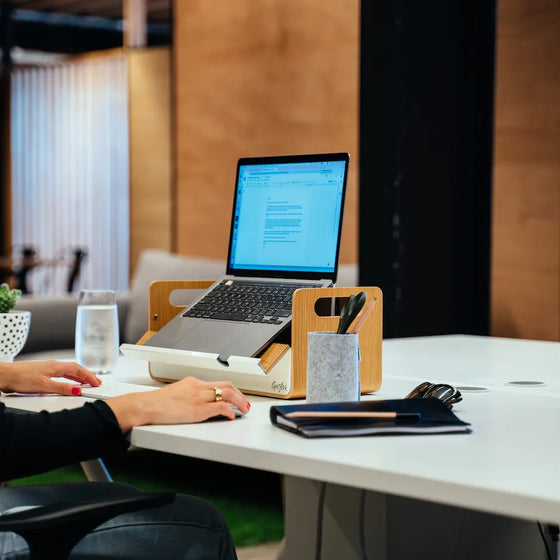
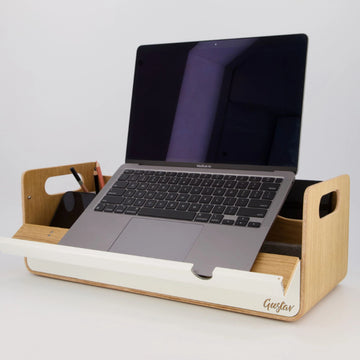
That means users are given a simple mobile setup: a structured way to carry essentials, place devices correctly, and clear the desk fully at the end of the session. Laptop stands, organisers, desk mats and compact tech storage are not decorative extras here. They are part of the operating model. If the office expects people to move, the tools need to move with them.
What makes this hybrid office rollout example credible
The pilot succeeds because it solves three practical tensions that often derail hybrid projects.
The first is standardisation versus personal comfort. Facilities teams need consistency. Users need a workstation that feels usable within moments. The answer is not to personalise every desk permanently. It is to standardise the desk and make personal setup portable. When employees can carry the items that shape their working posture and organisation, they regain familiarity without undermining desk sharing.
The second is cleanliness versus usability. A clean desk policy can keep the office visually calm, but if every desk feels stripped back to the point of inconvenience, people resist it. In this rollout, the desk itself remains clean and clear, but the user experience does not feel sparse. Essential tools are simply brought to the desk when needed and removed just as easily.
The third is efficiency versus adoption. It is tempting to measure success by occupancy rates alone. But a full office is not automatically a successful office. The better measure is whether people can use the space with less effort. In the pilot, the team tracks setup time, booking reliability, storage pressure, complaints about ergonomics and informal behaviour such as users hoarding equipment. Those signals reveal far more than attendance figures on their own.
From pilot to full rollout
Once the pilot data is reviewed, the firm refines the standards before expanding. Some desks are too close to collaboration zones and need acoustic separation. The number of lockers is increased because mobile work still requires a dependable place for shoes, coats and backup equipment. A small bank of touchdown spaces is added near reception for colleagues between meetings.
The rollout then moves floor by floor. This phased approach matters because hybrid work is behavioural as much as physical. Teams need time to understand what each setting is for, what should be carried with them, where items belong at the end of the day and how desk etiquette supports everyone else. A rushed launch often creates the impression that the model itself is flawed, when the problem is simply poor onboarding.
In this example, communication is concise and visual. Each workspace type has a clear purpose. Each employee receives a practical setup guide. Managers are briefed separately, because they influence whether teams treat the office as a shared resource or try to recreate assigned seating through habit.
There is also an important procurement decision. Rather than buying large numbers of duplicate desk accessories to leave in place, the firm invests in fewer, better mobile tools that users can rely on across locations. This supports consistency between home and office while reducing clutter in shared environments. It also respects a basic truth of hybrid work: people do not want to relearn their setup every time they change desks.
Where office accessories shape adoption
This is often the overlooked layer of a hybrid office rollout example. Floor plans and policies get attention because they are visible at leadership level. But the tactile, everyday experience of setting up work is what users remember.
A shared desk without portable organisation quickly becomes a landing zone for cables, notebooks, chargers and ad hoc storage. A laptop used flat on the table for hours compromises posture. Small items go missing. People start arriving early to secure the few desks that feel easier to use. These are not minor irritations. They shape whether the workplace feels well designed or merely reallocated.
Portable, design-led workspace tools solve a specific operational problem. They help users create an organised workstation in seconds, then return the desk to a neutral state just as quickly. In a desk-sharing environment, that is not only convenient - it protects the clarity of the space.
For workplace strategists and designers, this creates a stronger bridge between concept and behaviour. The office remains visually calm. Employees have what they need close at hand. Storage becomes more intentional. Ergonomic support does not depend entirely on fixed furniture. And because the setup travels with the user, the experience stays more consistent across home, office and project space.
The trade-offs to plan for
No rollout is friction-free, and a useful example should say so.
Some teams adapt immediately, especially those already working across multiple locations. Others need a clearer structure, particularly if they are moving from long-established assigned desks. Senior stakeholders may focus on utilisation data while employees focus on comfort and convenience. Both perspectives matter, and the rollout has to satisfy both.
There is also a design trade-off between minimalism and provision. A beautifully sparse workspace can photograph well and still fail in daily use. On the other hand, over-equipping every desk defeats the purpose of flexibility and often leads to visual noise. The right balance is usually a well-specified shared base layer, combined with portable personal equipment.
It also depends on the organisation’s rhythm. A consultancy with frequent client travel may need more touchdown space and less individual storage. A public sector team with fixed attendance peaks may need more predictable booking rules. A creative studio may prioritise project zones over silent desk density. The rollout model should adapt to the work, not the other way round.
What success looks like after launch
Six months on, the firm in this hybrid office rollout example is not calling the project finished. It is calling it operational. That is a better sign. Occupancy is more balanced across the week. Shared desks turn over cleanly. Fewer users leave equipment behind. Setup time is down, and complaints are less about missing basics and more about fine-tuning specific zones.
Most importantly, the office feels intentional. People can move through it without carrying the disorder of a fixed-desk culture into a flexible one. The workplace supports hybrid behaviour because it has been designed around real use - from booking logic and space planning to storage, ergonomics and the small tools that make temporary workstations feel complete.
For organisations planning their own rollout, the lesson is straightforward. Start with behaviour, not theory. Test before scaling. And do not treat the individual desk experience as a minor detail. In hybrid environments, that detail is often where the strategy either holds together or quietly falls apart.
A well-planned office does more than allocate space. It helps people arrive, settle and work well - wherever their day begins.