How does a clean desk policy work in daily practice?

On Monday morning a shared desk often still feels neutral. By 11 am charging cables, notebooks, coffee cups and printouts reveal how quickly a surface becomes a personal storage place. It is precisely at this point that the practical question arises: how does a clean desk policy work so that it not only looks good on paper but actually improves everyday working life?
The short answer is: not through signs or strict emails alone. A clean desk policy works when rules, spatial planning and the right tools fit together. It is not an end in itself. It should increase security, make space use more efficient and enable calmer, more professional working in hybrid work environments.
How does a clean desk policy work in daily practice?
At its core a clean desk policy requires employees to leave their workspace without confidential documents, devices or personal items left in plain view. Depending on the company this applies at the end of the day, for longer absences or at every desk change. In desk-sharing-oriented environments the requirement is usually higher, because the same desk is used by several people.
For this to run smoothly, clear standards are needed. What exactly needs to be put away? Are paper notes considered critical? May headsets or monitors be left in place? Where are documents stored? Who is responsible for the area when several teams use the same zone? As long as these questions remain open, the policy will remain vague.
The most effective guidelines are therefore concrete and visually comprehensible. An empty desk does not mean that every workspace must appear sterile. It means that nothing confidential, nothing valuable and nothing unnecessary remains permanently in plain view. The workspace is returned to a defined basic state after use.
Why companies introduce a clean desk policy
The most common trigger is data protection. Printouts with customer data, contract documents, handwritten meeting notes or visible access information are a real risk in many industries. This risk is often underestimated, especially in open-plan offices, where there are visitors, or in hybrid teams with changing presence.
There is also space efficiency. Desk sharing only works well if workstations can be taken over quickly. A desk on which the remains of the previous day are piled up is effectively blocked — even if it is officially free. That costs time, causes frustration and undermines acceptance of flexible workplace models.
There is a third factor that is less often openly named but decisive in everyday life: appearance. An orderly workspace signals care, calm and professionalism. This applies not only to customer appointments or internal meetings. Employees themselves often work more concentrated when the environment is clearly structured.
What separates a good policy from a bad one
Many clean desk policies fail not because of the idea but because of the implementation. They are either worded too strictly or too vaguely to actually change behaviour. A good policy provides orientation. A bad policy generates resistance.
If employees feel that they must dismantle their setup completely after every short meeting, the rule will be perceived as a burden. If, on the other hand, no one knows what is expected, individual behaviour will reassert itself. Both are problematic.
The appropriate design therefore depends on the working model. In a traditional office with fixed desks it may be sufficient to lock away sensitive documents securely at the end of the day. In an activity-based workplace with changing zones significantly more consistent standards are needed. There a free desk is only truly usable if personal work tools are mobile and can be stowed quickly.
The four building blocks that make it work
1. Clear rules instead of general appeals
The policy must be understandable. Employees should be able to grasp in a few sentences what is expected when leaving the workspace. It makes sense to distinguish between confidential documents, technical devices, personal items and shared equipment.
Language is also important. Anyone who demands discipline only will inspire little enthusiasm. Anyone who explains that the policy improves data protection, facilitates cleaning, supports desk sharing and leaves everyone with a usable workstation will create significantly more acceptance.
2. Storage that matches everyday work
A clean desk policy without storage space is only a good intention. Employees need lockers, mobile organisers, bag solutions or other formats with which work tools can be moved safely and quickly. The more flexible the working model, the more important this mobile organisation becomes.
This often decides whether the policy is practical. Anyone who has to rummage awkwardly for a laptop, mouse, charger, documents, pens and headset will experience compliance as an additional effort. Someone who can take a compact, well-thought-through setup with them in seconds accepts the change much more easily.
3. Workstations that are deliberately standardised
A clean desk concept benefits from consistently designed workstations. If every desk is equipped similarly, employees have to improvise less. This reduces the urge to hoard accessories permanently or to occupy surfaces individually.
Standardisation does not mean arbitrariness. Especially in high-quality work environments it can go very well together with design standards. What matters is that ergonomics, connection options and order are considered. A tidy desk only appears convincing if it also functions well.
4. Leadership and culture
Policies become visible in the habits of leaders. If team leaders themselves leave piles of paper or leave meeting rooms untidy, any rule loses credibility. Conversely, good role modelling shapes the culture faster than any intranet reminder.
It helps to position the clean desk policy not as control but as part of a professional working environment. Then it is more likely to be understood as a shared standard — similar to leaving meeting rooms tidy or treating shared areas with respect.
Where the typical friction points are
Not every activity fits equally well into a strict clean desk model. Teams with high paper use, confidential case files or complex project documents have different requirements from purely digital knowledge work. Creative processes can also deliberately produce visible intermediate states. A rule that is too rigid can be counterproductive in those cases.
That is why differentiation pays off. Some areas may need additional storage spaces or protected project zones instead of being reset completely every day. Other teams manage perfectly well with a clear end-of-day standard. It is not about treating every workstation identically, but about establishing a sensible minimum standard.
Another friction point is the emotional side. In hybrid offices a too anonymous workspace can quickly feel cold. People want to orient themselves, settle in and work with concentration. The solution is not more disorder but a better personal setup. Mobile, high-quality work tools create familiarity without blocking shared spaces.
How a clean desk policy works particularly well in hybrid offices
Hybrid working environments place different demands on a policy than the traditional private office. Employees switch between home, the office and being on the move. They therefore need systems that combine mobility and order rather than a purely stationary organisation.
This is exactly where the quality of the workstation solution becomes decisive. If everything essential can be transported in a compact, well-organised format, desk changes become routine rather than a disruption. That not only supports the policy but also improves the overall user experience of the office.
For workplace managers this is a strategic point. A clean desk policy is strongest when it is not based on abstinence but on better infrastructure. Allowing employees to personalise their workstation quickly and to free it again just as quickly increases acceptance, usability and calm in the room.
What employees need to understand concretely
For users the policy should not remain abstract. In practice it must answer three questions: What do I take with me? What stays in place? Where does everything go when I leave?
When these three answers are clear, routine develops. Personal technology and documents are packed away, shared equipment is left orderly, sensitive information disappears from sight. The principle is that simple. It only becomes difficult when companies set expectations but do not provide a functioning environment.
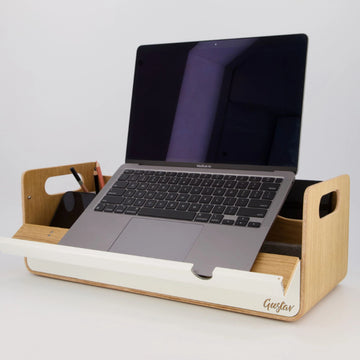
A design-oriented setup can achieve more than might be assumed at first glance. Good organisers, bags and portable workstation solutions reduce visual noise and shorten set-up times. For modern workplaces this is not a detail but part of the function. Gustav approaches it from exactly that perspective: mobility, organisation and high-quality use belong together.
When a clean desk policy fulfils its purpose
A policy is not successful when nobody leaves anything on the desk. It is successful when workstations are reliably available, sensitive information remains protected and the environment looks professional without becoming impersonal.
This does not require overly complicated rulebooks. It requires clarity, appropriate tools and a workstation design that supports rather than obstructs behaviour. Then a directive becomes a habit — and order a real advantage in the hybrid daily routine.
The best test is very simple in the end: can someone leave the place in a few seconds, and can the next person use it productively just as quickly? If the answer is yes, the clean desk policy works not only formally but in the way modern work needs it.