12 Best Desk Accessories for Hybrid Working

A shared desk at 09:15 should not feel like a compromise. Yet when a laptop, charger, notebook, headset and water bottle arrive as separate items, even a well-designed workplace can become cluttered before the first meeting begins. The best desk accessories for hybrid working bring order to that transition: they make essential tools easier to carry, quicker to place and more comfortable to use.
The right choices are not necessarily the most numerous. They are the ones that support a repeatable setup across the office, home and third spaces, while respecting the different needs of focused work, video calls and collaborative sessions.
The best desk accessories for hybrid working
1. A portable desk organiser
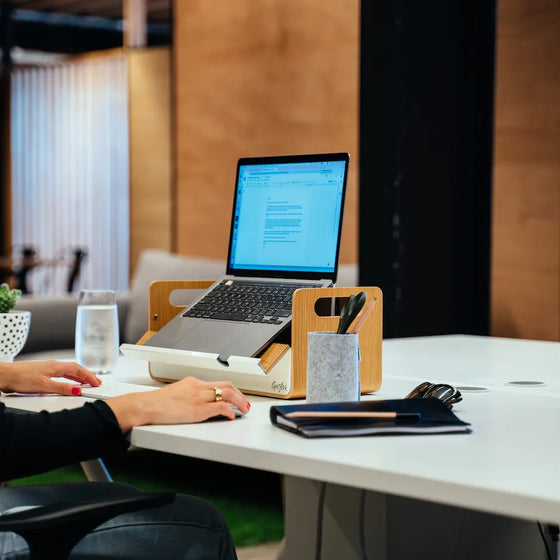
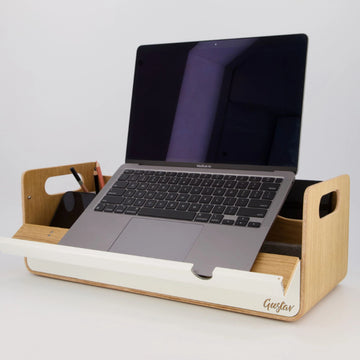
For hybrid workers, the organiser is the starting point. It keeps cables, chargers, stationery, adapters and personal essentials together, so users are not rebuilding their workspace from loose items every morning. More importantly, it creates a clear boundary between what belongs to the individual and what belongs to the shared desk.
Look for a structured organiser that can travel easily but also hold its form on a desk. A considered design should offer accessible compartments without becoming another bulky bag to carry. Gustav’s portable organisers are designed around this exact moment: arrive, place, open and begin.
2. An ergonomic laptop stand
A laptop at desk height is rarely at eye level. Over a full day, that encourages users to look down, round their shoulders and work in a less comfortable position than necessary. A compact laptop stand raises the screen, creating a more appropriate viewing height and a clearer separation between display and keyboard.
For a fixed home office, a larger stand can be suitable. In a desk-sharing environment, folding or lightweight models are often the better choice because they travel with the user and store neatly afterwards. Stability matters more than an elaborate mechanism. The stand should feel secure, set up quickly and accommodate the laptop sizes used across the team.
3. A separate keyboard and mouse
Once a laptop is raised, its built-in keyboard is no longer practical for extended work. A slim wireless keyboard and a comfortable mouse complete the ergonomic arrangement, allowing the screen and hands to sit at more natural heights.
This is an accessory pair rather than two isolated purchases. Choose them together, considering typing feel, battery management and how easily they pack away. For workplace teams, standardising a small number of compatible models can reduce support issues while giving every desk user a familiar experience.
4. A desk mat with a defined purpose
A desk mat does more than protect a surface. It establishes a visual work zone on a shared bench, provides a consistent surface for a mouse and reduces the small sense of disorder caused by scattered objects. On hard, reflective or heavily used desks, it can also make the workspace feel warmer and more deliberate.
Material and size should match the setting. A generous mat works well in a dedicated home workspace, while a lighter, portable format is more useful for hot-desking. Avoid mats that dominate a compact desk or require too much effort to roll, clean and carry.
5. A compact cable management kit
Cable clutter has an outsized effect on how a workspace feels. It catches on bags, disappears behind desks and makes a carefully planned setup look temporary. A few simple accessories - cable ties, a cable pouch and a small desk clip - can keep power leads and adapters where they are needed.
The aim is not to hide every cable permanently. Hybrid workers need a system that moves with them. A pouch protects chargers in transit; clips keep active cables from falling to the floor; ties prevent spare lengths becoming a tangle. This is especially valuable for people moving between meeting rooms, touchdown spaces and home.
6. A charging solution that travels well
Power is the non-negotiable accessory. A compact multi-port charger can reduce the number of plugs in a work bag and make a limited number of desk sockets go further. It is particularly useful where a laptop, phone, wireless keyboard and headset all need charging across the week.
There is a trade-off between capacity and portability. A high-output charger may suit a consultant carrying multiple devices, while a lighter option can be enough for a laptop and phone. Check the devices your team actually uses before choosing one. The best solution is the one that removes duplicate chargers without creating a power bottleneck.
7. A protective tech pouch
A well-organised tech pouch makes the mobile parts of work easier to manage. It gives cables, a power supply, presentation remote, adapters and small peripherals a known place, rather than allowing them to collect at the bottom of a bag.
Choose a pouch with enough structure to protect contents and enough flexibility to fit into a work bag. Internal organisation should be clear at a glance. Over-compartmentalised designs can be frustrating when a user needs to pack quickly after a meeting, while an empty cavern simply relocates the clutter.
8. A headset stand or storage point
Headsets are now part of the everyday desk kit, but they are often left on keyboards, monitor arms or the back of a chair. A dedicated hook or compact stand protects the headset, keeps the desk surface clear and makes the next video call easier to begin.
In a shared workplace, this accessory also supports clean-desk routines. The headset is either in use, stored with the user’s kit or placed in one obvious location. That small degree of order makes a difference at the end of a busy day.
9. A portable document holder
Paper is not gone, particularly for planners, designers, finance teams and anyone reviewing detailed material. A document holder prevents printed pages or a notebook from occupying the same limited area as the keyboard and mouse. It also reduces repeated neck movement between a screen and a document.
A lightweight, adjustable holder is usually the most adaptable option. It can support a notebook, reference sheets or a tablet, then fold down for storage. For roles centred on long document review, it is a practical ergonomic addition rather than a desk extra.
10. A small personal light
Lighting is one of the least consistent parts of hybrid work. Home workspaces may be poorly positioned for daylight, while shared offices can prioritise general illumination over individual task comfort. A compact, adjustable desk light can improve visibility for reading and provide a more considered appearance on video calls.
Choose a light with controlled brightness and a focused footprint. The goal is useful task lighting, not another large object competing for space. In offices with a clear-desk policy, a portable model that returns to a bag at the end of the day is the sensible choice.
11. A reusable water bottle or cup with a stable base
This may sound peripheral, but drinks are a frequent source of crowded desks and avoidable spills. A quality bottle or cup with a secure lid gives a user one reliable hydration point without sacrificing valuable work surface.
Keep it compact and position it consistently, ideally away from a laptop and papers. In a flexible office, the benefit is as much about routine as design: every item has a place, including the one people reach for most often during a long call.
12. A work bag that acts as a mobile base
The most effective hybrid setup starts before the desk. A well-designed work bag protects the laptop, carries the organiser and tech pouch, and makes it possible to move through the day without a collection of separate cases. It should be professional enough for client meetings while remaining practical on public transport and in a shared workplace.
Capacity is only one measure. Consider weight, internal structure, access to frequently used items and whether the bag supports the way someone actually travels. A larger bag may suit a worker carrying samples or documents; a more compact format may be better for a laptop-first routine.
Choose accessories as a system, not a collection
The strongest hybrid workspaces are built around a simple sequence: carry the essentials, create an ergonomic position, manage power, then clear the desk at the end of the day. Accessories should support that sequence rather than add visual noise or additional decisions.
For workplace planners, this also means looking beyond individual products. A consistent mobile setup can help employees settle into shared desks faster, protect a clean-desk policy and give flexible environments a more personal, considered feel. For individual workers, it means arriving with fewer loose items and leaving with everything accounted for.
Choose the pieces that make your working day feel more intentional. When every essential has a place, any desk can become a capable place to work.