How to Choose a Desk Organiser for Home Office

A home office can look settled while still working against you. A charger drifts behind the laptop, notebooks gather at the edge of the desk, and the tools needed for a video call are always one drawer too far away. The right desk organiser for home office use changes that rhythm. It gives essential work tools a defined place, keeps the surface calm and makes a focused setup easier to recreate each morning.
For hybrid professionals, the question is not simply how much an organiser can hold. It is whether it supports a workspace that feels considered, comfortable and ready for the next work mode. A well-designed solution should earn its place on the desk through function, material quality and the freedom to move when required.
Start with the way your desk actually works
The most useful organiser follows the flow of a working day. Before choosing one, look at what remains on your desk from the first task to the last: laptop, power supply, phone, notebook, pens, headphones, adapters or a second screen. These are the items that need a dependable home. Everything else can be stored elsewhere.
A compact desk used mainly for laptop work needs a different approach from a larger setup with paper documents and peripherals. On a narrow desk, a deep tray may consume more working space than it saves. A vertical or portable organiser can create order without spreading items across the surface. On a generous desk, a wider format can define a dedicated zone for smaller tools while leaving the main area clear for writing and focused work.
It also helps to consider what happens after work. If the desk sits in a bedroom, living room or shared room, visual calm matters as much as access. An organiser that gathers the daily essentials allows the workspace to be put away with intention rather than left as a collection of loose objects.
A desk organiser for home office work should reduce friction
Organisation is not about storing every object out of sight. It is about reducing the small interruptions that break concentration. Reaching for a cable, searching for a pen or moving items before opening a notebook may seem minor, but these repeated movements make a setup feel less efficient than it should.
Choose compartments according to the objects you use, not according to an abstract idea of tidiness. A place for a charging cable should prevent tangles while keeping the cable easy to reach. A phone position should support quick checks without turning the device into the centre of the desk. A document slot should hold current papers upright rather than creating another horizontal pile.
The best layouts balance visibility and containment. Frequently used tools should be visible at a glance. Smaller accessories and visual clutter benefit from being contained in a tray, pouch or covered section. This creates a desk that feels composed without requiring you to remember where everything has gone.
Keep the working zone clear
The area immediately in front of the laptop or monitor is valuable. It is where hands, notebooks and ideas need room. Avoid filling this zone with fixed containers simply because they appear neat. Instead, place the organiser to one side, behind the screen, or in a format that can be lifted away when the work changes.
This principle is especially relevant for people who alternate between typing, sketching, reviewing documents and taking calls. A desk should adapt quickly. An organiser that becomes an obstacle is just another form of clutter.
Portability is a practical advantage at home
Home office organisation is often treated as permanent, but many working routines are not. You may move from a dedicated room to the kitchen table, take your essentials to a shared workplace, or clear the desk for family life at the end of the day. A portable organiser turns these transitions into a simple reset.
Look for an integrated way to carry the core setup rather than a collection of separate holders. The difference is significant: one object that gathers laptop accessories, writing tools and personal work items is easier to move, easier to put away and less likely to leave something behind.
For desk-sharing environments, this approach supports a clean desk policy without making employees feel temporary. A personal organiser creates a consistent working zone wherever it is placed. At home, it offers the same benefit: your office can appear when needed and disappear with equal ease.
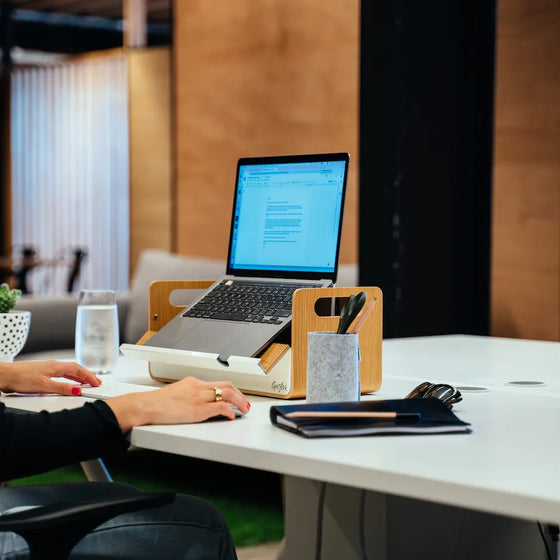
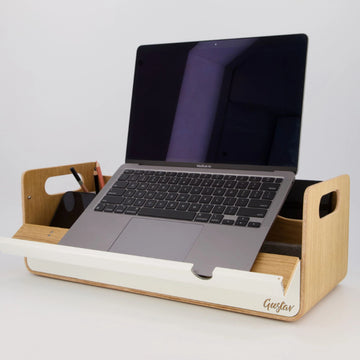
Gustav approaches this as a complete mobile workspace, combining organisation with the practical needs of flexible work rather than treating storage as an afterthought.
Choose materials that suit the room and the routine
A desk organiser is in constant view, so its material has a direct effect on how the workspace feels. Plastic can be useful where low weight and easy cleaning are the priority. Yet in a professional home office, it can also make a carefully chosen desk feel more temporary than intended.
Wood brings warmth and visual stability, particularly in rooms that serve more than one purpose. When sourced from sustainably grown wood, it can also support a more considered material choice. Recycled fabrics and durable soft materials work well for pouches and portable elements, helping protect cables and accessories while reducing hard edges in a compact setup.
The trade-off is straightforward. A heavier organiser may feel more stable and substantial on a fixed desk, while a lighter one is easier to carry between locations. Neither is automatically better. Choose based on whether your setup stays in place, moves regularly, or needs to do both.
Look beyond the first impression
Premium design is not only about a clean silhouette. Check whether edges are comfortable to handle, whether compartments are sized for modern devices, and whether the organiser remains stable when partially loaded. Consider how easily surfaces can be cleaned and how the item will look after months of daily use.
Durability matters because an organiser becomes part of a routine. Products made with care, sound materials and a clear purpose tend to age more gracefully than disposable desk accessories. A two-year warranty is also a useful sign that the product is designed for regular use rather than short-term novelty.
Support better ergonomics without overbuilding the desk
Organisation and ergonomics are closely connected. When cables, accessories and documents are under control, it becomes easier to position the laptop, screen and keyboard properly. The desk feels less crowded, so there is more freedom to set the screen at a comfortable height and keep the main work area aligned with the body.
An organiser is not a replacement for an ergonomic laptop stand or an external keyboard where those are needed. It should, however, support them. The strongest setups make each part work together: the screen is raised, cables are directed, the keyboard has room, and frequently used items remain within easy reach.
Avoid building a desk around too many individual pieces. Several small trays, holders and stands can create a fragmented look and make cleaning harder. A coordinated workspace system often feels calmer because every component has a relationship to the next. This matters in design-conscious interiors and in shared spaces where a clear visual language supports a sense of order.
Build a setup that is easy to reset
The measure of a good organiser is what happens at 17:30, not just what it looks like at 09:00. Can you clear the desk in under a minute? Can the laptop accessories travel together? Can the room return to its other purpose without a drawer full of tangled cables?
A simple reset routine keeps the system working. Return the daily essentials to the organiser, remove cups and loose paper, then leave only the furniture and core equipment visible. This is not about rigid rules. It is about making the next start feel clear rather than inherited from the last task.
Choose fewer, better-defined places for the objects you use every day. When your tools can move with you, your desk organiser becomes more than storage: it creates a calm, professional workspace wherever the workday begins.