A Guide to Hybrid Workstations That Work

A shared desk at 9am should not require ten minutes of cable untangling, chair adjustment and searching for a charger before useful work can begin. A well-designed hybrid workstation makes the transition feel considered: open your essentials, position your screen, clear the surface and start. This guide to hybrid workstations explains how to create that experience across home offices, desk-sharing floors and the spaces in between.
Hybrid work is not one setting. It is a sequence of settings, each with different constraints. The goal is not to recreate a permanent desk everywhere. It is to give people a reliable foundation for focused, comfortable work wherever they sit.
What makes a hybrid workstation work?
A hybrid workstation is a portable, repeatable work setup that turns an available table into a functional place to work. It combines the essential physical elements - screen position, power, organisation and personal tools - with a simple routine that can be repeated without friction.
The distinction matters in a desk-sharing environment. A tidy office can still feel poorly planned if each employee has to carry loose cables, notebooks and accessories from locker to desk, then spend the first part of the day building a workstation from scratch. Equally, an elegant home office may become uncomfortable if the laptop remains flat on the table for hours.
The best setups balance four requirements: ergonomics, portability, organisation and visual calm. Over-prioritise portability and the kit can become too limited for sustained work. Add too much equipment and moving between locations becomes burdensome. The right answer depends on how often someone moves, the type of work they do and what the workplace already provides.
Start with the work, not the desk
Before selecting accessories, map the working patterns the workstation needs to support. A consultant who spends most days between client sites needs a lighter setup than a designer working three days a week from a shared studio. A facilities team planning a new desk-sharing area needs to consider how hundreds of different users will arrive, settle and leave.
Look at three practical questions. How long will people work at one desk? What equipment is already available there? And what do they need to carry themselves to work comfortably and without visual clutter?
For short touchdown sessions, a compact organiser and easy access to charging may be enough. For a full day of concentrated laptop work, screen height and external input devices become more significant. For employees moving between lockers, meeting rooms and desks, a carry solution that also keeps documents, a bottle and personal work tools in order can remove a surprising amount of daily friction.
This approach also prevents a common mistake: treating every desk as if it needs the same equipment. Standardise the experience, not necessarily every object. A consistent setup routine gives users confidence, while allowing the kit to suit their role.
Design the setup around ergonomics
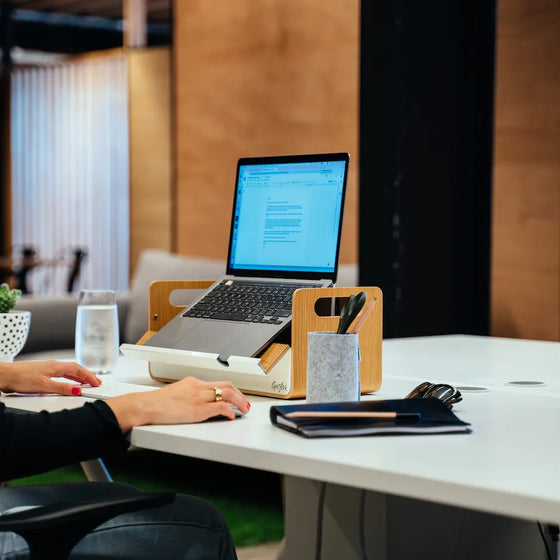
Laptop work is convenient, but convenience can create a poor working position when it becomes the default for a full day. The screen is often too low, which encourages the head and neck to angle downwards. Raising the laptop brings the display closer to a more comfortable viewing height and establishes a clearer working zone on a shared table.
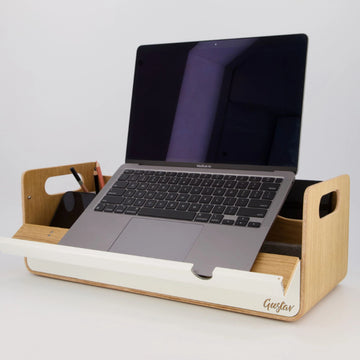
A portable laptop stand is therefore not a decorative extra. It is the structural element of a hybrid workstation. Choose one that opens quickly, sits securely and has a footprint suited to the tables people actually use. If the laptop is raised for extended periods, pair it with a separate keyboard and mouse where practical. This creates a more natural arm position while retaining the benefits of better screen height.
Ergonomics also depends on the furniture around the setup. The chair should allow the feet to rest comfortably on the floor or a footrest, while the desk needs enough depth to place the screen at a sensible distance. If a workplace uses varied table heights, test the complete setup on each one. An accessory that performs well on a dedicated desk may feel less effective at a high table or compact meeting table.
There is no single perfect position for every body or task. The more useful principle is adjustability. Users should be able to arrive, make a few simple changes, and create a comfortable position without hunting for equipment or rearranging half the room.
Make organisation part of the workstation
Clutter is not only visual. It creates small interruptions: the cable that has slipped behind a table, the adaptor left in a meeting room, the pen needed for a quick note but buried in a bag. In flexible offices, these interruptions are amplified because there is no permanent drawer to absorb them.
Give every essential item a defined place. A desk organiser can separate charging tools, stationery and smaller devices from the rest of the work surface. A compact tech organiser keeps cables, power supplies and adaptors together when travelling or changing desks. The value is not simply tidiness. It is knowing what to pack, where to find it and whether anything has been left behind.
Keep the desktop deliberately selective. The core items should be the laptop, stand, input devices, notebook and a charging connection. Everything else should either have a home in the organiser or remain in the bag until needed. This supports clean-desk policies without making a workstation feel impersonal.
Material choice has a role here, too. Durable wood and recycled felt can bring warmth and texture to an otherwise standardised office, while staying appropriate for a professional setting. In shared workplaces, these details help a temporary desk feel purposeful rather than provisional.
Build a portable kit with clear layers
A hybrid kit works best when it has layers. The first layer is always carried: laptop, phone, charger, keys and any role-specific essentials. The second layer creates the workstation: laptop stand, mouse, keyboard, cables, notebook and organiser. The third layer is optional, such as a headset, external webcam, presentation adaptor or documents for a particular meeting.
This makes packing quicker and reduces the tendency to carry unnecessary items. It also helps workplace teams decide what belongs with the employee and what should be provided at the desk. Fixed shared infrastructure, such as monitors, power and docking points, can reduce the amount employees need to transport. Personal organisers and portable stands then provide continuity between locations.
For desk sharing, consider the journey from locker to desk as part of the workstation design. A portable desk-sharing bag that unfolds into an organised work surface can make this transition more direct. Instead of moving a collection of loose items, users carry one structured system and set up with the same sequence each time.
Gustav Original, DeskMate, Loop and Echo are designed around this principle: the essentials remain organised in transit, then become useful at the desk rather than disappearing into a bag.
Plan hybrid workstations for shared spaces
Individual accessories perform best when the wider workspace supports them. Desk-sharing areas need enough power, appropriate chairs, reliable connectivity and surfaces that are large enough for a laptop-based setup. They also need clear expectations about clearing desks at the end of use.
Workplace strategists and office planners should test a full user journey rather than assessing furniture in isolation. Ask an employee to arrive with their daily kit, choose a desk, set up, join a video call, move to a meeting and pack down again. The points of hesitation reveal the practical gaps. Perhaps sockets are hard to reach, lockers are too small for a work bag, or the meeting rooms lack a place to set down personal equipment.
Visual consistency matters, particularly in client-facing offices and design-led environments. A small palette of considered organisers can help desks look orderly even when used by different people every day. This is not about making every workspace identical. It is about giving flexibility a recognisable standard of quality.
A simple setup routine people will use
The most successful hybrid workstation is one that takes seconds to establish. Begin by placing the organiser and opening the laptop stand. Position the laptop, connect power, then take out the keyboard, mouse and notebook if the work session calls for them. Keep cables routed close to the equipment rather than spread across the table.
At the end of the day, reverse the sequence. Return small accessories to their assigned compartments, check the charging cable and adaptor, fold the stand and clear the desk completely. This makes the next person’s arrival easier and protects the employee from leaving an essential item behind.
For organisations, this routine should be demonstrated, not merely described in a policy document. A sample workstation at an office launch or a short visual guide near lockers can establish the expected standard quickly. The tone should be supportive: this is a better way to arrive ready, not another layer of administration.
A hybrid workstation earns its place when it removes decisions from the start and end of the day. Create a kit that travels well, supports the body and keeps the desk calm, and every available table becomes a more dependable place to do good work.