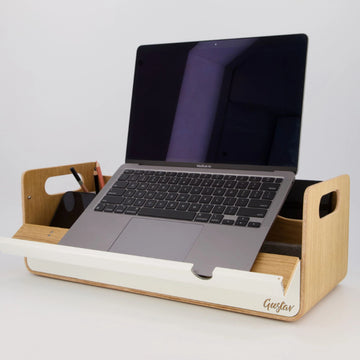
How to Choose a Laptop Stand That Works

A laptop stand can change the way a desk feels in seconds. Raise the screen to a more considered height, clear space beneath the device and a temporary workstation becomes a place you can settle into. But knowing how to choose a laptop stand means looking beyond its silhouette. The right choice must support your body, your laptop and the way you move between home, office and shared desks.
For a fixed home office, weight and range of adjustment may lead the decision. In a desk-sharing environment, a stand also needs to pack away quickly, travel well and help restore a clear desk at the end of the day. Good design is not simply about lifting a screen. It is about making a flexible workspace feel intentional.
Start with your working posture
The primary job of a laptop stand is to bring the top of the screen closer to eye level. When the screen sits too low, many people lean forwards or bend their neck for hours at a time. Raising it supports a more upright, relaxed viewing position and can make longer stretches of focused work more comfortable.
There is no single perfect height. It depends on your chair, desk, body proportions and the laptop itself. As a practical starting point, aim to position the top third of the display around eye level, with the screen roughly an arm’s length away. If you use progressive lenses or prefer to look slightly downwards at the screen, a lower setting may feel more natural.
A raised laptop changes where the keyboard sits, too. Once the screen is at a useful height, the built-in keyboard is usually too high for extended typing. For regular desk work, pair the stand with an external keyboard and mouse. This lets your shoulders stay relaxed, elbows remain close to your sides and wrists avoid an awkward upward angle.
If you only use the stand for short calls, presentations or occasional tasks, you may be comfortable typing directly on the laptop. Be honest about the duration. A compromise that works for twenty minutes is rarely the right setup for a full working day.
How to choose a laptop stand for your laptop
Start with fit. Check the supported screen size, maximum load and the depth of the supporting surface. A stand should hold the laptop securely without covering key ports, obstructing speakers or putting pressure on the display hinge. Larger 15- and 16-inch machines need enough width and a stable base. Smaller devices may benefit from a compact support that does not dominate the desk.
Consider the underside of the laptop as well. Some stands use a broad platform; others hold the computer on narrow front ledges. Both can work well, provided the contact points are protective, non-slip and positioned securely. Soft pads help prevent marks, while a raised structure can allow air to circulate beneath the device.
Port access matters more in a permanent workstation than it does in a meeting room. If you connect power, a display, storage or a docking station every day, check that cables can reach the ports without sharp bends or visual clutter. A stand should simplify the setup, not create a small engineering project each morning.
Choose the right adjustment style
Laptop stands generally fall into three useful categories: fixed-height, adjustable and fold-flat portable designs. The best option depends on how often the workstation changes.
A fixed-height stand is simple, stable and often visually calm. It suits a home office where the desk, chair and user remain largely consistent. Its limitation is obvious: if the desk changes, the stand cannot adapt.
An adjustable stand gives more control over height and viewing angle. This can be valuable where several people use the same workstation, or where the stand moves between a dining table, a dedicated desk and a hot-desk area. Look for adjustment that feels deliberate rather than loose. A stand should stay where you set it, even when you open the laptop or touch the screen.
Fold-flat designs are made for mobility. They take up little space in a bag and can turn a shared desk into a personal setup quickly. The trade-off is often a lower maximum height or less adjustment. For hybrid professionals, that may be the right balance. The most capable product is not always the one with the most mechanisms; it is the one people will actually carry and use.
Stability is a workplace essential
A laptop stand should feel secure from the first touch. Test for wobble at the height you expect to use, not only at its lowest setting. A stand can appear stable when folded close to the desk, then become less reassuring when fully extended.
Pay attention to the base footprint. A wide, well-balanced base usually offers greater confidence for larger laptops, while a carefully engineered fold-flat design can remain stable without occupying excessive desk space. Non-slip feet are valuable on smooth laminate, glass and communal worktables, where movement can be more noticeable.
The opening and closing action also matters. If a stand requires excessive force, catches fingers or needs several attempts to fold correctly, it will frustrate users in a busy office. Equally, a mechanism that is too loose may shift during use. Premium workspace tools earn their place through small, repeatable details: controlled movement, dependable contact points and a finish that remains composed after daily handling.
Match the stand to the way you work
The most suitable laptop stand is rarely chosen in isolation. Think about the full workspace system around it.
For a home office, consider the desk depth and whether the stand leaves room for a keyboard, mouse, notebook and task light. A stand with a considered footprint can create useful space beneath the laptop for a compact keyboard or a few essentials when they are not in use. Visual order matters here too. A cleaner surface makes a permanent workstation easier to return to each morning.
For desk sharing, portability becomes part of performance. The stand should pack neatly alongside a keyboard, mouse, charger and notebook, ideally within a portable organiser or work bag. It should set up without tools and pack away without leaving a trail of loose accessories across the shared desk. This supports clean desk policies while giving each person a consistent ergonomic starting point.
For frequent travel, prioritise slimness, weight and protection. A stand that is technically portable but awkward in a bag will spend more time in a drawer than on a desk. Consider how it sits beside other work essentials and whether its edges, joints and surfaces are designed for repeated movement.
Look beyond the mechanism
Material choice affects both the experience and the lifespan of a laptop stand. Metal can offer a precise, lightweight structure. Wood brings warmth and a more furniture-like presence to a home or hospitality-inspired office. Recycled materials can be a considered option when the manufacturer is transparent about their use and the product is built for long-term daily service.
The finish should suit its environment. In a client-facing studio or carefully planned workplace, a stand becomes part of the visual language of the desk. At home, it may need to sit comfortably alongside existing furniture rather than look like temporary equipment. Choose a design that feels calm from every angle, including when the desk is unoccupied.
Durability is also practical sustainability. Look for solid construction, replaceable or resilient protective pads where relevant, and clear care guidance. A product designed to travel should withstand being packed, unpacked and used across different surfaces without quickly looking worn. Gustav, for example, approaches mobile workspace tools through durable materials, considered portability and a two-year warranty.
Avoid the common buying mistakes
The most common error is choosing height without considering typing. A tall stand may improve the screen position but create a poor keyboard position if no external input devices are available. The second is choosing portability without checking stability. Thin and light are useful only when the laptop still feels secure.
Another mistake is buying for an ideal desk rather than the desks you actually use. If you work across home, office and client spaces, assess the smallest, shallowest or most crowded surface in that routine. A stand that works there will usually work everywhere else.
Finally, do not confuse more adjustment with better ergonomics. Extra hinges and angles are useful only if they help you reach a comfortable, repeatable position. A simple stand with the right height, stable support and a natural setup routine can be the more intelligent choice.
A well-chosen laptop stand should disappear into the rhythm of work: open it, place the laptop, connect what you need and begin. When it makes every desk feel calmer, more comfortable and ready for the task ahead, it is doing far more than holding a screen.