How to Set Up Anywhere and Work Better

The difference between a good workday and a frustrating one often starts in the first two minutes. You arrive at a shared desk, a meeting room, a home office corner, or a quiet table between appointments, and the question is immediate: can you get working quickly without compromising comfort, order, or professionalism? That is what how to set up anywhere really comes down to - creating a workspace that is fast to establish, easy to carry, and consistent across locations.
For hybrid professionals, workplace planners, and teams working in desk-sharing environments, speed matters. But speed alone is not enough. A temporary setup that leads to poor posture, cable clutter, or missing essentials soon becomes inefficient. The better approach is to think of mobility as a design problem. If each tool has a purpose and place, your workspace becomes repeatable.
How to set up anywhere starts with consistency
The biggest mistake in mobile work is treating every location as a fresh start. It feels flexible, but it creates friction. You waste time unpacking, adjusting, searching, and improvising. A better setup is built around a consistent kit that travels with you and performs the same way whether you are at home, in the office, or working elsewhere for the day.
That consistency should cover three things: ergonomics, organisation, and visual calm. Ergonomics protect comfort and concentration over longer sessions. Organisation reduces setup time and prevents the small interruptions that break momentum. Visual calm matters more than many people assume. A clear, intentional workspace feels easier to use, especially in shared environments where clutter quickly becomes noise.
This is why premium mobile workspace tools are not simply accessories. They are part of a system. When your laptop stand, pouch, desk organiser, work bag, and mat all support one another, setup becomes almost automatic.
Build around the essentials, not the extras
If you want to know how to set up anywhere well, start by removing anything that does not earn its place. A mobile workspace should be complete, but it should not be overpacked. Every item should solve a specific need.
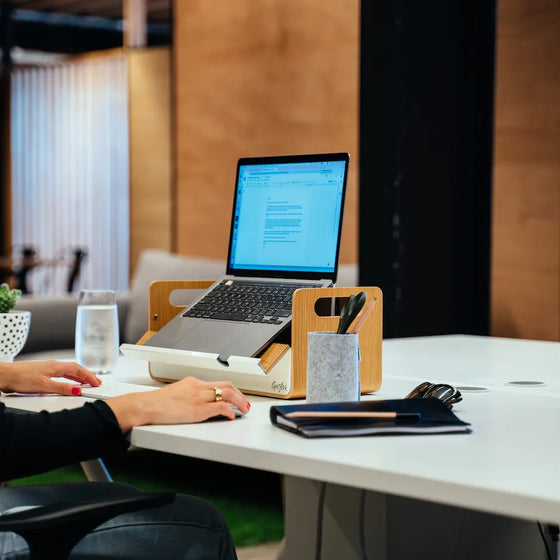
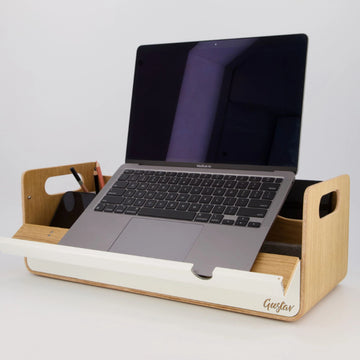
The laptop is the centre of most modern setups, yet using it flat on the desk for hours is rarely ideal. Raising the screen improves viewing height and encourages a better sitting position. That usually means adding a compact laptop stand and, depending on the length of your work session, an external keyboard and mouse. This combination creates a more comfortable working posture without turning your bag into a storage problem.
From there, organisation becomes the next layer. Loose chargers, adapters, pens, earbuds, notebooks, and cables are manageable when you are working at one permanent desk. In mobile work, they become the reason setup feels chaotic. A dedicated organiser or tech pouch keeps essentials grouped and easy to access. It also makes packing faster because you can see immediately what is missing.
A desk mat is another detail that often proves its worth once it becomes part of the routine. On a shared desk it defines your workspace clearly. On less polished surfaces it adds comfort, protects materials, and creates a more stable, professional base for daily work. It is a small move with a noticeable effect.
Think in setup zones
One useful way to improve mobile work is to think in zones rather than objects. Instead of asking what to carry, ask what your workspace needs to function.
The first zone is your work zone - laptop, stand, keyboard, mouse, notebook. The second is your power zone - charger, cable, adapter, power bank if needed. The third is your personal essentials zone - mobile phone, earbuds, keys, access card, and the small items that often end up scattered across the desk. When these zones are packed intentionally, setup becomes a sequence rather than a search.
This matters particularly in desk-sharing offices, where a clean desk policy and shared surfaces mean people need to arrive, work, and clear the space efficiently. It also matters in home settings, where the workspace may need to disappear at the end of the day. A well-designed portable system supports both.
The best setup is the one you can repeat
There is no single perfect layout for everyone. A consultant moving between client sites needs something different from a designer working partly from a studio and partly from home. A workplace strategist planning flexible office standards will think differently again. But the principle remains the same: the best setup is repeatable.
Repeatable means it fits your bag without strain, sets up in moments, and supports the kind of work you actually do. If your routine includes long writing sessions, ergonomics deserve more attention. If you move frequently during the day, speed and compactness may take priority. If you are specifying solutions for teams, durability and visual consistency across a workplace become central.
How to set up anywhere without creating clutter
Clutter rarely begins with too many objects. It begins with too little structure. When every item has no fixed location, even a minimal kit can feel messy.
The most effective mobile setups use containment well. A work bag should not be a large empty space where accessories drift. It should support separation between devices, documents, and smaller tools. Inside that, organisers and pouches create another layer of order. This gives users what many shared workplaces are missing: a sense of control over their immediate environment.
It also improves transitions. The move from desk to meeting room, from office to train, or from home workspace to dining table is much easier when everything returns to a designated place. This is where design quality becomes practical, not cosmetic. Thoughtful materials, clear compartments, and durable construction are not just aesthetic choices. They support everyday use over time.
Ergonomics still matter in temporary spaces
Portable should never mean compromised. Many people accept discomfort because they assume mobile work is temporary by nature. In reality, temporary setups often become the default setup. A few hours here and there quickly add up.
That is why ergonomic support deserves a place even in a compact workspace kit. Raising the laptop, keeping frequently used tools within comfortable reach, and creating enough desk definition to avoid hunching over a small surface all make a measurable difference. You do not need a full office rebuild to work more comfortably. You need a few well-chosen elements that travel well.
For employers and workplace decision-makers, this has wider implications. If teams are expected to move fluidly across settings, their tools should support healthy, consistent working positions wherever they are based that day. Mobility works best when it includes physical ease, not just logistical ease.
Design the routine, not just the bag
A strong mobile setup is partly about products and partly about behaviour. Even the best tools work better with a simple routine around them.
Pack the same way each day. Return every item to the same place. Keep only active essentials in your daily carry. Review the kit regularly and remove what is no longer useful. These are small habits, but they reduce mental load. They also make the workspace feel intentional rather than improvised.
For teams, the same logic applies at scale. If an office supports flexible work, employees need clear, well-designed ways to carry, store, and re-establish their tools. Otherwise, flexibility shifts effort on to the user. Good workplace design removes that effort where possible.
This is where a design-led approach stands apart. A mobile workspace should not feel like a compromise made necessary by changing work patterns. It should feel like a better standard for contemporary work - organised, portable, and calm. Gustav has built its approach around exactly that idea: your office, anywhere.
What a well-set mobile workspace should feel like
When a setup is working properly, you notice it less. You sit down, unpack in moments, and start without friction. The screen is at a better height. The desk feels clear. Cables are where they should be. The tools you need are present, and the ones you do not need are not competing for space.
That result looks simple, but it is designed. It comes from selecting fewer, better tools and making them work together. It also comes from understanding that workspace quality still matters when the workspace moves.
Knowing how to set up anywhere is not about copying one fixed arrangement from place to place. It is about creating a portable system that protects focus, supports comfort, and brings a sense of order to every setting. When that system is well designed, work feels lighter from the moment you put your bag down.