How to Support Clean Desks That Last

A desk is usually untidy for a reason. Not because people do not care, but because the workspace asks them to do too much with too little support. One person lands for two hours between meetings, another works there all day, a third arrives with a laptop, charger, notebook, headset, water bottle and nowhere sensible to put any of it. If you want to understand how to support clean desks, start there. Clean desks are not created by reminders. They are created by design.
Why clean desks fail when the setup is wrong
Many organisations treat desk cleanliness as a behavioural issue. The policy says clear your workspace at the end of the day, so the assumption is that compliance should follow. In practice, people leave clutter behind when the environment makes order inconvenient.
A desk without accessible storage becomes a holding zone. Loose cables stay out because packing them away takes too long. Personal devices remain on the surface because there is no dedicated place to carry them. Papers collect because no one has defined what should stay at the desk and what should move with the user.
This is even more visible in hybrid offices and desk-sharing environments. The more fluid the workplace, the less effective fixed storage becomes. Large pedestal drawers and permanent desk ownership solve the wrong problem. What people need instead is a way to arrive, unpack quickly, work comfortably, and leave no trace without friction.
How to support clean desks in modern workplaces
Supporting clean desks starts with accepting that cleanliness is part of workflow, not a finishing task. If people need five minutes to set up and another five to pack away, the system is already under strain. The best desk-sharing environments reduce both actions to seconds.
That usually means shifting from desk-based storage to person-based organisation. Portable organisers, structured tech pouches, compact work bags and modular accessories all help users keep essentials together rather than scattered across a surface. When every item has a defined place before it reaches the desk, clutter drops naturally.
It also helps to think in layers. The desk surface should support active work only. The items in use now can stay visible. Everything else should have a nearby home, ideally one that travels with the user. That distinction sounds simple, but it changes behaviour. A clean desk becomes the default state rather than an end-of-day clean-up exercise.
Prioritise mobility over fixed storage
In traditional office planning, storage was attached to furniture. In flexible work, it is more effective when storage moves with the person. A mobile worker does not benefit much from a drawer assigned to one location if they use different desks throughout the week.
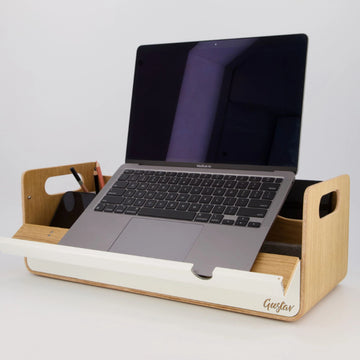
Portable desk organisers are especially effective because they bridge setup and storage. They allow users to carry daily essentials, place them on the desk in one motion, and maintain visual order while working. At the end of the day, the same system packs up just as quickly. That supports consistency across home offices, shared offices and touchdown spaces.
There is a design consideration here too. If portable storage looks improvised, people are less likely to use it well. Well-made organisers with durable materials, thoughtful compartments and a professional finish tend to stay in use because they feel like part of the workspace rather than an afterthought.
Reduce cable sprawl at the source
Cables are one of the fastest ways to make a clean desk look temporary and chaotic. They also signal a setup that was not designed for movement. If every user needs to reassemble chargers, adapters and peripherals from scratch, cable clutter is almost guaranteed.
The answer is not always fewer devices. Sometimes a team genuinely needs a laptop, external keyboard, mouse, headset and charging kit. The better approach is to package these tools as a compact personal setup. When chargers and accessories are stored together in a dedicated pouch or organiser, the desk stays clearer and setup becomes faster.
Where possible, workplaces should standardise what is provided at the desk and what employees are expected to bring. Ambiguity creates duplication. Duplication creates clutter. A clear equipment logic supports cleaner surfaces and fewer abandoned items.
Support clean desks without making the office feel sterile
A clean desk should feel calm, not impersonal. This is where many implementations go wrong. In trying to eliminate visual noise, some workplaces strip desks back so aggressively that they become less usable and less welcoming.
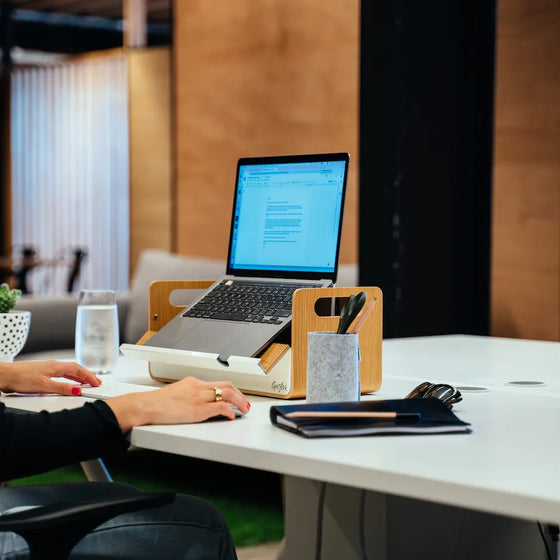
People still need comfort, ergonomics and a sense of control over their setup. Laptop stands, desk mats and compact accessories can all support clean desks while making work more comfortable. In fact, they often do both at once. A desk mat can visually define the work zone and reduce scattering. A laptop stand can lift the screen while shrinking the footprint of the setup. A well-designed organiser can hold personal tools without making the desk feel busy.
The trade-off is space. On smaller desks, every object needs to earn its place. On larger shared workstations, there is more room for semi-permanent accessories. The right answer depends on how long people typically stay at a desk, how often they move, and whether the office prioritises focused individual work or short-term touchdown use.
Make setup intuitive in shared environments
If a workspace requires explanation, it will rarely stay tidy. Shared desks need to communicate their logic immediately. Users should understand where to place their bag, where cables route, where accessories sit and what should be cleared away when they leave.
This does not require heavy signage or rule-based messaging. Often, the physical setup can do the work. A defined area for active tools, a separate place for portable storage and a restrained selection of desktop accessories all help people mirror the intended behaviour.
Architects, interior designers and workplace planners often focus on the macro layout first, which is understandable. But clean desk performance is won at the small scale. The details of what sits on a workstation, how it moves and how it is stored have an outsized effect on whether the whole space feels organised.
The role of product design in clean desk habits
Good workplace habits are easier to maintain when products are designed around them. That may sound obvious, but it matters. A clean desk policy is only as strong as the objects people use every day.
Poorly designed accessories create secondary clutter. Bulky laptop stands are left behind because they are awkward to carry. Soft pouches lose structure and become difficult to pack efficiently. Cheap organisers wear quickly and stop looking appropriate in a professional setting. Over time, people revert to ad hoc solutions, and the desk becomes fragmented again.
By contrast, products designed for portability and repeated daily use support cleaner routines almost invisibly. Materials matter because durable, premium finishes encourage care and long-term use. Structure matters because it keeps tools in place. Ergonomics matter because if a setup is uncomfortable, people will improvise, and improvised setups are rarely tidy.
This is where design-led workspace tools earn their place. They do not just store objects. They shape behaviour. Gustav approaches this with a clear principle: the workspace should be portable, organised and ready to perform wherever work happens.
How to support clean desks across teams, not just individuals
There is a limit to what one employee can do if the wider system is inconsistent. Clean desks work best when workplace strategy, furniture planning and personal tools support the same outcome.
For facility managers and HR leaders, that means looking beyond policy language. Ask whether people can actually clear a desk without carrying loose items in their arms. Ask whether shared workstations support quick setup without cable clutter. Ask whether the storage solution matches hybrid patterns or still reflects an older one-person-one-desk model.
For designers and specifiers, the question is similar. Does the workstation encourage short, controlled setups with a minimal footprint, or does it invite accumulation? Are materials and accessories aligned with a calm visual standard? Is there enough flexibility for people to work comfortably without personalising the desk into semi-permanence?
The strongest clean desk environments balance discipline with ease. They are structured, but not rigid. Premium, but not precious. Organised enough to stay clear, and flexible enough to support real work.
A genuinely clean desk is not empty. It is intentional. When every tool has a purpose, every item has a place and every user can set up and pack away without effort, cleanliness stops being a rule to enforce. It becomes part of how the workspace works.