A Mobile Team Setup Example That Works Anywhere

A good mobile team setup example is not a row of identical hot desks with a few spare monitors. It is a considered system that lets every employee arrive, unpack, work comfortably and leave a clear desk without losing time or personal order. The difference is felt in the first five minutes of the day.
For workplace teams, the aim is consistency without rigidity. People need a reliable way to carry their essentials, establish a comfortable working position and make a shared desk feel ready for focused work. The office remains calm and adaptable, while each person retains a sense of ownership over how they work.
A mobile team setup example for a 40-person office
Consider a 40-person consultancy operating with 24 shared desks, several meeting rooms and a mix of office and home working. Employees choose a desk according to the work they need to complete that day. Some require a quiet focus area, while others work close to project teams. No one has a permanently assigned workstation.
The office provides the fixed infrastructure: a quality chair, monitor, power, keyboard and mouse at each desk. Employees bring the personal layer of the workstation with them. This includes their laptop, notes, chargers, headset, stationery and the small items that otherwise end up scattered across shared surfaces.
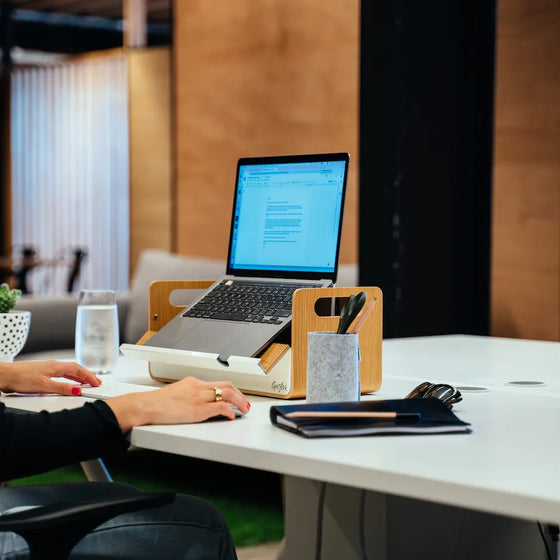
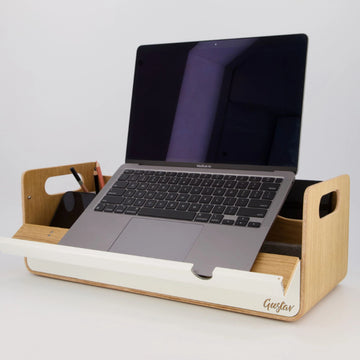
Each team member receives a portable desk-sharing bag, such as DeskMate, as their daily workstation carrier. It holds documents and a water bottle alongside technology, then opens to keep essentials visible and organised. A laptop organiser and stand, such as Gustav Original, creates a raised screen position in seconds. A compact organiser keeps cables, adapters and stationery together rather than loose at the bottom of a bag.
The result is simple: the desk is shared, but the setup feels personal. Employees are not rebuilding their working environment from scratch every morning. They are placing a well-designed, familiar system on a different surface.
What the employee experience looks like
At 09:00, an employee arrives and chooses an available desk through the workplace booking system. They place their bag beside the desk, connect the laptop to the monitor and unfold the organiser. Their laptop is raised to a more comfortable height, the keyboard and mouse are positioned below, and their notebook, charging cable and pen are placed in a defined location.
At 11:30, they move to a project room. Their essentials close back into one portable system, rather than being gathered from several drawers and desk corners. Later, they return to a focus desk or leave for home with the same working kit intact.
At the end of the day, the desk is cleared in under a minute. The next person finds a clean, fully equipped workspace rather than a collection of abandoned cables, coffee cups and anonymous stationery. This is where a clean desk policy becomes practical rather than performative.
Build the setup around three working layers
A successful mobile setup separates what belongs to the office, what belongs to the employee and what must travel between both.
The shared desk layer should be stable and ready to use. Adjustable seating, a monitor, power access and reliable peripherals remove the need for employees to transport heavy equipment. If this layer is inconsistent across the office, people will naturally gravitate towards a handful of preferred desks and desk sharing begins to break down.
The personal work layer should be compact, organised and recognisable. It is where individuals keep their laptop, documents, charging equipment and everyday accessories. A portable organiser is more effective than a loose collection of pouches because it gives every item a place at the desk as well as in transit.
The ergonomic layer bridges the two. A laptop stand supports a more comfortable visual height when the laptop is used independently, while an external monitor can take over for longer desk-based work. Not every employee needs the same configuration, but each should have a simple route to an appropriate posture without searching for equipment.
Choose tools that reduce setup friction
The best mobile workplace tools earn their place by removing small points of friction. A beautiful organiser that is awkward to carry will stay in a locker. A bag with generous capacity but no internal order simply moves clutter from the desk to the shoulder.
Look for a system that supports the full working cycle: carrying, setting up, concentrating, moving and packing away. Materials also matter. Products made with sustainably grown wood and recycled felt can bring warmth and visual calm to offices otherwise defined by screens and hard surfaces, while remaining suited to daily use.
For individual employees, a small tech organiser such as Echo can keep chargers, cables and adapters contained. At the desk, a recycled PET felt organiser such as Loop can hold the accessories that make a workspace feel settled without claiming permanent territory on a shared surface. These are modest details, but they reduce visual noise and make clearing down far more likely.
There is a trade-off to manage. Some teams need to carry paper files, larger headsets or specialist equipment, and will need a more capacious bag. Others work almost entirely digitally and may prefer a lighter organiser-led setup. Standardise the principle, not every object. The essential requirement is that each employee can carry their complete personal work layer in one coherent system.
Make desk-sharing rules visible and reasonable
Mobile work fails when expectations are left implied. Employees should know what is supplied at every desk, what they are expected to bring and where personal items belong when a desk is not in use. Clear guidance prevents the familiar morning hunt for a charger or the frustration of arriving at a desk with missing equipment.
A short setup standard is often enough. It should define the available desk equipment, the expected clear-desk state and the location of shared supplies. It should also clarify responsibility for faults. If a monitor cable is damaged or a chair needs attention, reporting it must take less effort than ignoring it.
Avoid rules that make people feel temporary or unwelcome. The goal is not to strip personality from the workplace. It is to give people a dependable base that works for everyone. Personal tools can bring colour, material character and familiarity to a desk during the day, then leave no burden for the next user.
Support different work modes
A mobile team does not need a single desk format. Focus work, short touchdown tasks, video calls and collaborative sessions place different demands on the workspace. The common thread is portability: an employee should be able to move between these settings with the tools needed to remain organised.
For example, a designer may begin at a monitor-equipped desk, carry their setup to a review room with a notebook and samples, then work from home the following day. A project manager may use a quiet desk in the morning and spend the afternoon in meetings. Their workspace system should support these shifts without creating repeated packing, unpacking and cable management problems.
Measure whether the setup is actually working
Before expanding a desk-sharing programme, test the setup with a representative group for several weeks. Observe where bags are placed, which accessories remain on desks and how long people take to get ready for work. These behaviours reveal more than a general satisfaction score.
Ask specific questions. Do employees have enough space for their daily essentials? Can they find and connect what they need without assistance? Is laptop use comfortable when a monitor is unavailable? Are desks consistently clear at the end of the day? If the answer to any of these is no, the issue may be equipment, layout or unclear operating rules.
Workplace leaders should also look at the visual result. A well-run flexible office appears composed throughout the day, even when every desk is in use. Personal tools are present with purpose, not spread across the floorplate. That quality signals care to employees, clients and visitors alike.
Design for the journey, not just the desk
The strongest mobile team setup does more than equip a workstation. It respects the journey between home, office, meeting room and locker, while giving employees a reliable place to work at each stop. When portability, organisation and ergonomics are designed as one system, shared desks feel less like a compromise and more like a workplace that is ready for the way people actually work.