Top Products for a Clean Desk Policy at Work

A clean desk policy can fail at 5.30pm if people have nowhere practical to put their charger, notebook, headset and personal work tools. The top products for clean desk policy success do more than make a desk look tidy. They give every employee a simple way to carry, contain and reset the essentials of work.
For workplace teams, the goal is not an empty desk for its own sake. It is a workplace that is ready for the next person, easy to maintain and comfortable to use. The right products make that standard feel natural rather than enforced.
What a clean desk policy needs to work
A policy sets an expectation. A well-designed workspace system makes it achievable. In desk-sharing offices especially, employees need to move between lockers, meeting rooms, focus spaces and shared desks without leaving a trail of cables, stationery and documents behind.
The most effective products support three moments in the working day: carrying essentials from place to place, creating an organised setup quickly, and clearing the desk just as easily. Products that solve only one of these moments can still help, but they often create friction elsewhere. A cable tidy is useful, for example, but it cannot replace a portable organiser when an employee is moving between floors.
Materials matter too. In visible, shared spaces, accessories should look considered while standing up to repeated daily use. Durable construction, calm colours and thoughtfully defined compartments make organisation part of the workplace experience rather than another rule to remember.
Top products for a clean desk policy
1. A portable desk organiser with laptop support
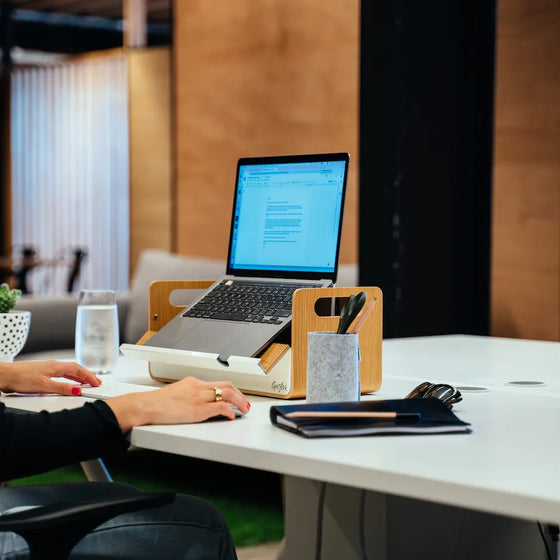
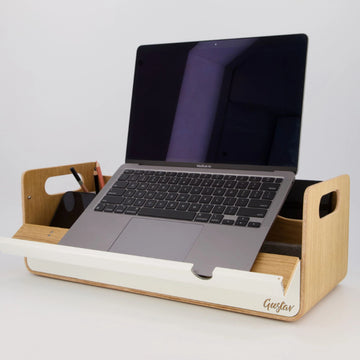
For many hybrid teams, a portable organiser is the foundation of a clean desk policy. It creates a designated home for the small items that otherwise spread across the desktop: a phone, pens, charging leads, adapters, notebook and headphones. When those items travel together, fewer are left behind.
The strongest designs also raise the laptop to a more comfortable viewing height. This matters because employees should not have to choose between an ergonomic setup and a desk that can be cleared in seconds. An organiser that becomes a laptop stand gives each person a familiar, functional workstation at any shared table.
Gustav Original is designed around this dual purpose. Its award-winning format turns a clear surface into an organised, ergonomic workstation in moments, then folds down for the journey home or to the next desk. For workplace planners, this reduces the need to permanently equip every touchdown space with individual desktop accessories.
There is a trade-off to consider. A compact organiser is ideal for laptop-led work and short desk sessions, while employees handling large paper files or specialist equipment may need more carrying capacity. The best approach is to match the organiser to the work modes your office actually supports.
2. A desk-sharing bag for everyday movement
A clean desk policy becomes far easier when employees have one place for their full working kit. A purpose-designed desk-sharing bag helps move a laptop, documents, water bottle and personal accessories from locker to workstation without several loose items in hand.
Unlike a conventional work bag, a desk-sharing bag should contribute to the setup once it reaches the desk. Compartments for essentials reduce rummaging, protect equipment and make packing down more consistent. This is particularly valuable in large offices, where a small delay at every move can quickly become a noticeable source of frustration.
Choose a bag with enough structure to keep documents and devices upright, but not so much bulk that it becomes inconvenient on public transport or between meetings. It should support a whole working day without encouraging employees to claim more desk space than they need.
3. A compact tech organiser for cables and chargers
Cables are one of the most common causes of visual clutter, and one of the easiest issues to prevent. A compact tech organiser keeps charging leads, power adapters, presentation clickers and smaller accessories together when travelling and contained when working.
This product is especially useful in offices with a mix of desk-based work, meetings and video calls. Rather than leaving a charger plugged into a shared desk or carrying cables loosely from room to room, employees have a dedicated place to return each item. The desk clears faster and equipment is less likely to disappear into a drawer or meeting room.
Look for a format that opens clearly, rather than a deep pouch where accessories become tangled. Echo, for example, is built to organise cables, chargers, stationery and daily essentials in a compact footprint. It works well as an individual item or as part of a wider mobile workstation system.
4. A desktop organiser for shared accessories
Not every item needs to travel. In some workplaces, it is useful to provide a small organiser at designated desks, collaboration zones or reception points for shared stationery and everyday accessories. The key is to define what belongs there and keep the selection intentional.
A felt organiser brings softness and colour to a workspace without creating visual noise. It can hold pens, sticky notes, glasses, a mouse or smaller technology while giving each object a clear place. Loop is made from recycled PET felt and is available in different colours and sizes, allowing workplace teams to align desk organisation with the visual language of a space.
This option works best where desks are used repeatedly throughout the day and a modest set of shared tools is genuinely needed. It is less suitable for a strict clear-surface policy if the organiser becomes a permanent storage point for abandoned personal belongings. Clear guidance on what stays and what goes is essential.
5. Cable management that supports fast reset
Cable management is often treated as a finishing detail. In shared workplaces, it is operational. Unmanaged leads make desks look untidy, complicate cleaning and create uncertainty over which charger belongs to whom.
Simple cable clips, sleeves and under-desk routing can keep fixed power connections in place, while personal charging cables should remain in each employee’s tech organiser. This distinction matters: building-provided connections stay at the desk; personal equipment leaves with its owner.
Avoid over-engineering the setup. If staff need to unplug and thread cables through a complicated system every time they move, they may simply leave items behind. The best cable solution is discreet, accessible and quick to understand at first use.
6. Lockers and personal storage that are close to the work zone
Accessories cannot carry the whole policy. Employees also need nearby, secure storage for coats, bags, confidential papers and items that do not belong on a desk. Without it, desks naturally become temporary cupboards.
For facility managers, locker location is as significant as locker quantity. Storage placed far from the work area adds friction at the beginning and end of the day, while conveniently located lockers make clearing down the natural final step before a meeting or commute. Where possible, provide enough room for a desk-sharing bag alongside personal belongings.
For confidential material, secure storage and clear document-handling procedures remain essential. A portable organiser can keep papers orderly during a work session, but it should not be treated as a substitute for appropriate secure storage.
Build a system, not a collection of objects
The most successful clean desk policies use products as a connected system. A typical employee journey might begin with a desk-sharing bag, continue with a portable organiser and laptop stand at the desk, and use a compact pouch to keep technology contained. Shared zones may add a small desktop organiser and fixed cable control where it serves a clear purpose.
This is more effective than buying isolated accessories because it answers the practical question employees ask every day: where does this go now? When every essential has an obvious home, clear desks become a by-product of good design.
Workplace teams should also pilot the system with different user groups before specifying at scale. Consultants, designers, finance teams and frequent travellers may carry different combinations of equipment. Observe what reaches the desk, what remains in lockers and what repeatedly gets left behind. That evidence will reveal whether the issue is product capacity, desk layout or unclear expectations.
A clear desk should still feel personal and ready for focused work. Give people tools that travel well, set up beautifully and pack away without effort, and the final reset becomes a quiet, reliable part of the working day.