9 Top Workspace Tools for Consultants

A consultant can lose ten minutes before the first meeting even starts - looking for a charger, raising a laptop on a stack of notebooks, hunting for a quiet place to write, or trying to work from a hot desk that was clearly set up for somebody else. The top workspace tools for consultants solve that problem fast. They reduce friction, protect focus and help create a professional setup wherever the day begins.
That matters more than ever in hybrid work. Consultants move between client offices, shared workspaces, trains, home offices and team hubs. The tools worth carrying are not the ones with the longest feature list. They are the ones that make setup quicker, work more comfortable and the desk feel intentional from the first minute.
What makes workspace tools right for consultants
Consulting work is rarely static. One day is spent in workshops, the next in analysis, the next in transit. So the best tools do three things well. They travel easily, they support concentration, and they help maintain a consistent way of working across changing environments.
There is also a clear trade-off. A fully equipped fixed desk may offer maximum comfort, but it does not help much when your workplace changes twice a day. On the other hand, an ultra-light setup can be easy to carry yet frustrating to use for six hours straight. The strongest consultant setups sit in the middle - portable enough to move, refined enough to use properly.
Top workspace tools for consultants that earn their place
1. A portable desk organiser
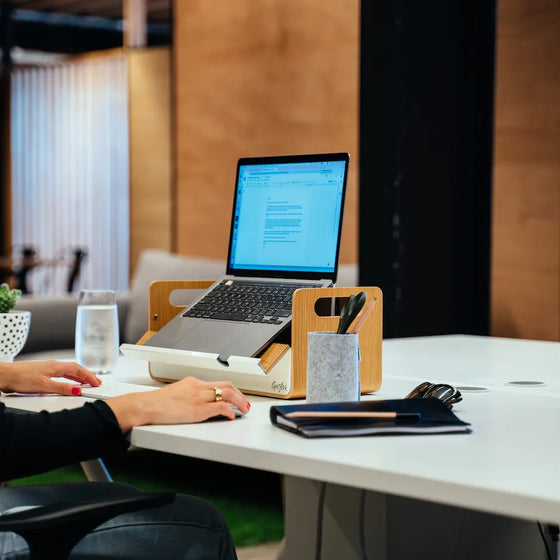
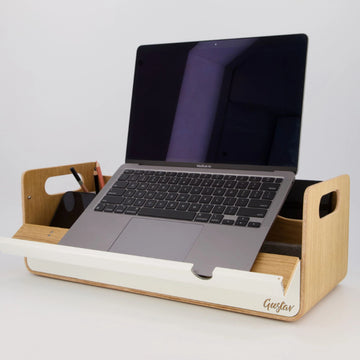
If one item defines a mobile workspace, it is the organiser that holds the essentials in one place. Pens, notebook, chargers, mouse, adapters and small personal items tend to scatter quickly across bags and desks. A portable desk organiser removes that mess and shortens setup time.
For consultants, this is less about tidiness for its own sake and more about control. You arrive, place the organiser on the desk, and the workspace is already structured. In desk-sharing environments, that matters. It supports clean desk policies while still allowing individuals to create a familiar setup in seconds.
The best organisers also work as a transport system rather than just storage. A well-made piece with defined compartments, durable materials and a calm visual language feels appropriate in a client boardroom as well as a home office.
2. A laptop stand that improves posture
Few things undermine a workday faster than poor screen height. Consultants spend long periods reviewing documents, building presentations and moving between calls. A laptop stand lifts the screen to a more suitable position and reduces the rounded posture that quickly appears on kitchen tables and temporary desks.
This is one of the most useful tools in any consultant kit, but only when it matches the reality of travel. Some stands are excellent ergonomically and terrible in a bag. Others fold flat but feel unstable once typing begins. It depends on how often the setup moves and whether an external keyboard is part of the routine.
For regular mobile work, a lightweight stand with quick deployment usually offers the best balance. It is not the most dramatic purchase, but it changes the quality of a working day immediately.
3. An external keyboard and mouse
A raised laptop screen only works properly when paired with separate input devices. Otherwise posture improves for the neck and worsens for the shoulders. A compact keyboard and mouse give consultants a more natural position and make longer tasks far less tiring.
This matters especially for strategy work, financial modelling, writing and slide production, where accuracy and comfort affect output. The key is choosing devices that are compact enough to travel without feeling compromised. Small does not have to mean cramped.
There is a case for keeping this setup simple. If a consultant spends most days moving between meetings with short bursts of desk work, carrying a full keyboard may not be worth it. But for anyone working several focused hours at a time, the improvement is clear.
4. A desk mat that defines the workspace
Desk mats are often treated as aesthetic extras. In practice, they are one of the simplest ways to make temporary desks feel usable. A good desk mat creates a visual and physical work zone, improves mouse tracking, protects surfaces and adds a small layer of comfort.
For consultants working in shared offices or client spaces, this can have a surprisingly strong effect. It marks out a controlled area for laptop, notebook and accessories without spreading clutter. The desk looks composed, and that visual order supports mental order too.
Material quality matters here. A flimsy mat can feel disposable, while a well-crafted one signals care and consistency. It is a modest tool, but in flexible environments modest tools often make the largest difference.
5. A tech pouch for cables and power
Every consultant knows the small panic of reaching for a cable that should be there and is not. Power accessories are easy to lose because they are rarely used all at once. A dedicated tech pouch keeps chargers, cables, adapters and earbuds together, which saves time and avoids the daily bag search.
The value is not only practical. It also helps maintain a cleaner desk. Instead of loose cables and miscellaneous accessories spreading across the surface, everything has a place and can be returned there quickly.
A pouch needs structure to work well. If it collapses into a soft pocket with no compartments, it becomes another layer of disorder. Better to choose one that separates essentials clearly and fits the actual devices you carry.
6. A notebook system that still works offline
Digital tools dominate most consulting workflows, but analogue thinking remains useful. A notebook is still one of the fastest ways to capture workshop insights, sketch frameworks or write down the one question that appears halfway through a client discussion.
The point is not nostalgia. It is flexibility. Consultants often work in settings where opening a laptop is awkward or distracting. A notebook makes sense in meetings, on trains and during site visits, and it creates a reliable backup when batteries run low.
The best approach is consistency rather than complexity. One notebook, one pen, and a clear habit for storing notes. When physical and digital systems start competing, both become harder to trust.
7. Noise management tools
Open-plan offices and shared spaces are rarely designed around deep work. Consultants need to switch quickly between collaboration and concentration, and noise is one of the biggest barriers. Headphones or discreet earplugs can make the difference between fragmented effort and usable focus.
What works depends on the task. For analysis or writing, active noise reduction can be valuable. For environments where awareness still matters, lighter sound dampening may be better. The goal is not to block everything out, but to create enough separation for clear thinking.
This is one of the few categories where preferences vary sharply. Comfort, audio quality and battery life all matter, but so does social context. In some client settings, large headphones send the wrong signal. Smaller, lower-profile options may be more appropriate.
8. A work bag designed for movement
The bag is not just a container. It determines how easy the rest of the setup is to carry, access and protect. Consultants need a bag that supports movement between locations without turning every transition into a repacking exercise.
A good work bag should fit the core system - laptop, stand, organiser, notebook, pouch and personal items - without becoming oversized. Too small, and tools are squeezed together. Too large, and the bag fills with things that never need to be there.
This is where design discipline matters. Well-considered compartments, durable materials and a professional silhouette support both utility and presence. For premium mobile work, the bag is part of the workspace itself.
9. A repeatable setup routine
Not every workspace tool is a product. One of the most effective tools for consultants is a repeatable setup routine: bag on chair, organiser on desk, stand up, keyboard out, water placed to one side, notebook open. The exact order can vary, but the principle is consistent.
Routines reduce cognitive load. They also make changing locations less disruptive because the workspace feels familiar even when the room does not. This is particularly useful in desk-sharing offices, where the physical desk may change every day.
Premium tools help, but the real gain comes from using them with intention. That is where design and performance meet.
Building the right consultant setup
The best consultant workspace is rarely the biggest one. It is the one that travels well and works without fuss. A portable desk organiser, a proper laptop stand, compact peripherals and a few well-chosen accessories create a setup that feels professional in almost any setting.
For some teams, that may mean a lighter kit built around mobility. For others, especially those spending long hours on focused desk work, ergonomics should take priority. There is no single formula. But there is a clear pattern: the most effective tools reduce friction, support posture and bring order to changing work environments.
That is why design quality matters. Thoughtful materials, durable construction and a restrained visual language are not superficial extras. They help consultants work with more clarity and show up with more consistency. Gustav has built its approach around exactly that idea - your office, anywhere.
Choose fewer tools, but choose better ones. The right setup should feel calm before the first meeting starts.