Wood Laptop Stand Review for Flexible Work

A laptop stand earns its place when the desk changes. One day that may be a home office table; the next, a shared workstation, project room or client site. This wood laptop stand review looks beyond the immediate appeal of timber and asks a more useful question: does the stand create a genuinely better place to work?
For professionals who move between work settings, the answer depends on more than appearance. A well-made wooden stand can bring screen height, visual calm and a sense of permanence to an otherwise temporary setup. But material alone does not guarantee good ergonomics, reliable stability or easy transport. Those details decide whether a stand becomes part of the working day or stays on a shelf.
What a wood laptop stand should improve
The primary job is simple: raise the laptop screen. When the display sits closer to eye level, users are less likely to spend long stretches folding towards the desk. The result can be a more comfortable visual position, particularly during video calls, focused writing and extended document work.
There is a limit. A laptop stand does not turn a laptop into a fully adjustable monitor arm, and it cannot suit every body height or chair setting. The most effective setup usually pairs the raised screen with an external keyboard and mouse. This separates display height from typing height, allowing both to be positioned more naturally.
That distinction matters in shared offices. A stand that works brilliantly for a quick 30-minute task may be less suitable for a full day of detailed work if its height is fixed at the wrong level. Review the stand in the context of the actual tasks, not only the clean product photograph.
A second benefit is spatial. Wood has visual warmth that can make a desk feel considered rather than improvised, especially beside the cooler surfaces of aluminium laptops and office tables. The right design does not merely lift a computer. It gives the desk a clearer hierarchy, with the screen above and the working area below left open for a notebook, keyboard and essentials.
Wood laptop stand review: the details that matter
Screen height and working posture
Start with the lift. Measure the height of the laptop screen once it is placed on the stand, rather than judging the height of the stand itself. A shallow angle may look low but place the display well; a taller structure may add bulk without producing meaningful elevation.
The best height depends on the user, chair and desk. In an office with standardised desks, a moderate lift often serves the widest range of people. At home, where chair and table combinations vary more, the stand needs to work with what is already there. A fixed wooden stand is elegantly simple, but it is a deliberate choice: it favours a consistent setup over broad adjustment.
Also consider the viewing angle. A laptop should sit securely while keeping the display easy to read without excessive glare. If the screen angle cannot be changed enough once mounted, its ergonomic value is reduced.
Stability without visual weight
A premium stand should feel settled from the first touch. It must hold the laptop without rocking, shifting or flexing when the desk is nudged. This is especially relevant in desk-sharing environments, where tables may be lighter, narrower or less forgiving than a dedicated home-office desk.
Look at the base footprint and the contact points between the stand, laptop and desk. Non-slip surfaces can protect the desk while helping the stand remain in position. The laptop should have secure support at its lower edge, with enough contact to feel safe but without obstructing essential ports, speakers or ventilation.
There is a trade-off here. A broad, heavy base can feel extremely stable, yet be inconvenient to carry from locker to desk. An ultra-light design may travel well but can feel less assured with larger laptops. The strongest options balance both demands through intelligent form rather than unnecessary material.
Material quality and finish
Wood is not one thing. Grain direction, thickness, edge treatment and surface finish all influence how a stand looks and performs over time. A refined piece should feel smooth at the points users touch most often, with clean edges that will not catch on a bag or mark a laptop.
Timber also makes each piece subtly individual. That variation is part of its appeal, but it should not be confused with inconsistent quality. Check that surfaces are even, joints are precise and the overall construction sits flat. A stand that looks elegant but wobbles on a table fails the most basic test.
For organisations specifying accessories at scale, material choice has another role: it influences the atmosphere of the workplace. Sustainably grown wood can bring a warmer, more residential quality to a shared environment while still looking appropriate in a professional setting. The best designs use that character with restraint, avoiding ornament for its own sake.
Portability and setup time
A wood stand is often chosen for its presence, not its compactness. That is reasonable for a permanent desk, but hybrid work asks more of an accessory. Can it move comfortably between home and office? Does it fit into a work bag without damaging other items? Can it be set up in seconds?
A portable stand should avoid loose pieces and fussy assembly. Components that detach may save space, but they also create opportunities to leave something behind. A single, self-contained structure is usually easier to use in a fast-moving office routine.
Weight needs context. If a stand travels every day, a few extra grams are noticeable. If it remains on a desk for weeks, a slightly heavier construction may be worthwhile for the stability and material presence it brings. The right decision follows the work pattern, not a universal rule.
Desk organisation beyond the laptop
The most useful stands recognise that a laptop is only one part of the workspace. Keyboard, mouse, charging cable, notebook, headset and mobile phone all compete for room on a shared table. A raised laptop can free up valuable surface area, but an overly complex stand can introduce new clutter.
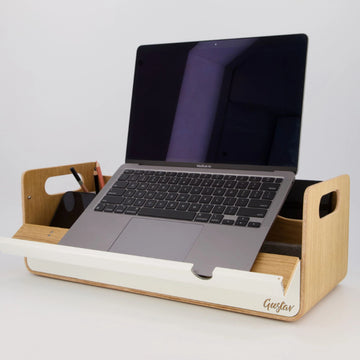
This is where an integrated organiser can make sense. Gustav Original, for example, combines an award-winning ergonomic laptop stand with desk organisation in one portable object. For users who repeatedly create and clear a workstation, that approach reduces the number of separate accessories to carry and helps establish a consistent setup wherever the day begins.
Integration is not automatically better. Someone with an established monitor, docking station and large desk may prefer a simpler stand. But for hot desking, project work and compact home setups, a design that contains everyday desk essentials can offer a more practical kind of premium: less to unpack, less to misplace and less visual noise.
Where wooden stands are not the best fit
An honest review should account for cases where another solution may be more suitable. If several people with very different heights share the same desk, a highly adjustable monitor system may offer greater flexibility. If the laptop needs to be packed into a very slim bag, the profile of a solid wood stand may be too substantial. And if work involves intensive typing directly on the laptop keyboard, raising the device can make the keyboard less comfortable to reach.
Wood also asks for sensible care. It is a durable, tactile material, but it should not be treated like a disposable plastic accessory. Keep it dry, wipe it with a soft cloth and avoid placing it where repeated spills or prolonged moisture are likely. In return, a quality wooden object can retain its character rather than simply looking worn out.
A considered choice for changing workspaces
The strongest wood laptop stands do not rely on material alone to justify their place. They raise the screen to a useful position, stay stable on varied desks, travel without friction and make the surrounding workspace easier to use. Their warmth is a benefit, but their function is the reason they last.
Before choosing one, try to picture the first five minutes of a real working day: opening the bag, claiming a desk, connecting power, arranging the keyboard and beginning. Select the stand that makes those five minutes feel calm, clear and repeatable. That is how a temporary table starts to feel like your office.