A Workplace Transformation Example That Works

A desk can look perfectly tidy at 9am and still fail the person using it. That was the issue facing a growing professional services team when it moved to desk sharing: the office was attractive, flexible and well equipped, yet employees were spending the first part of each day finding cables, adjusting screens and deciding where to put their belongings. This workplace transformation example shows why the details of individual setup matter as much as the floor plan.
The organisation had reduced its number of assigned desks and introduced a mix of focus spaces, collaboration tables, meeting rooms and touchdown areas. On paper, it was a sensible response to hybrid work. In practice, the transition exposed a familiar gap. A shared desk was available, but it did not always feel ready to work from.
The answer was not more furniture. It was a clearer system for helping people carry, arrange and use the essentials that make a desk feel functional in seconds.
The workplace transformation example: from shared desks to ready desks
Before the change, employees arrived with a laptop, charger, notebook, headphones, water bottle and a collection of small personal tools. Some stored these items in lockers. Others carried them between rooms. By mid-morning, cables had gathered around monitors, stationery was spread across shared surfaces and chairs were being adjusted repeatedly as people tried to create a workable posture.
None of these frustrations was dramatic on its own. Together, they weakened the value of the workplace. People could choose where to sit, but not always work comfortably once they got there. Facilities teams also found that clean desk standards depended on constant reminders rather than a setup that made tidiness the easy option.
The team reframed the question. Instead of asking, "How can we make every desk identical?", it asked, "What does each person need to make any suitable desk work for them?"
That shift changed the project from an interiors exercise into an employee experience programme. The workplace strategy stayed flexible, but the personal workstation became more considered.
Step one: define the minimum viable workstation
The project group mapped the first five minutes of a typical desk-sharing day. A person needed to place their bag, connect power, raise their laptop when appropriate, organise small items and begin work without claiming more space than necessary.
This led to a simple workstation standard: every shared desk should provide reliable shared infrastructure, while each employee should have a compact, portable kit for personal organisation and ergonomic adjustment. The distinction was useful. Screens, docks, power and seating remained part of the office. The items that travel with a person remained personal, contained and easy to put away.
A standard does not mean every employee works in exactly the same way. Designers may need materials close at hand; consultants may move between project rooms; analysts may use a larger screen throughout the day. The aim was consistency where it removed friction, not uniformity for its own sake.
Step two: make mobility feel intentional
A common failure in desk-sharing offices is treating mobility as an inconvenience employees must manage alone. When people have no practical way to carry their work tools, they improvise with tote bags, loose chargers and stacks of paperwork. The office then feels temporary, even when the design is premium.
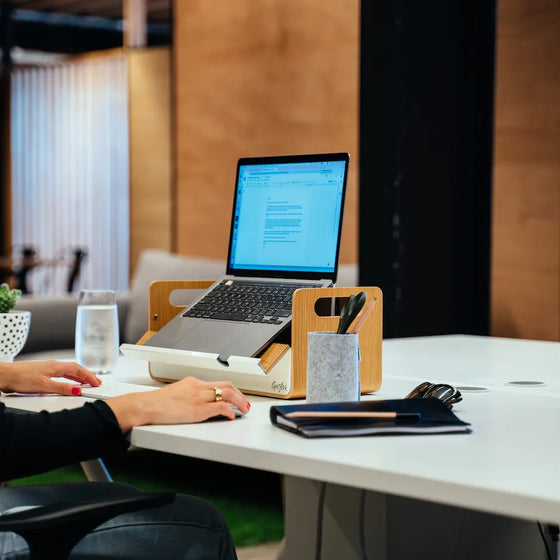
The organisation introduced portable organisers and desk-sharing bags as part of the workplace kit. Each employee could move from locker to desk, meeting room or home without unpacking a random collection of accessories. The kit created a clear place for cables, chargers, pens, documents and personal desk items.
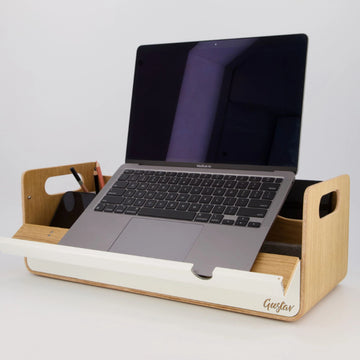
This is where product design has a direct effect on behaviour. A portable organiser that opens into a defined workstation gives each item a place before work begins. A bag designed for desk sharing can keep a laptop and daily essentials together while reducing the number of separate objects carried around the office. Gustav Original and DeskMate suit this role because they combine portable organisation with a fast, considered setup.
The principle matters more than any single product. The chosen tools need to be durable enough for daily movement, compact enough for lockers and meeting rooms, and refined enough to belong in a professional environment.
Step three: treat ergonomics as a daily condition
Ergonomics is often discussed as a procurement category: choose a good chair, provide monitor arms, meet a specification. Those elements are essential, but flexible work adds another layer. A workstation only supports good posture when it can be adjusted easily by the person using it.
In this example, desks with external monitors remained the preferred option for longer focused work. However, employees were also using project tables, quiet rooms and home workspaces where a monitor was not available. A portable laptop stand gave them a more comfortable screen height in those situations, particularly when paired with an external keyboard and mouse where appropriate.
There is a trade-off. Portable tools should not be used to compensate for poor shared desk infrastructure. If employees spend whole days at a desk, suitable seating, display options and power remain fundamental. But a portable ergonomic layer makes a flexible workplace more resilient. It supports the moments when work moves beyond the ideal desk.
Step four: design for reset, not just setup
The most successful part of the transformation appeared at the end of the day. Employees could pack away their work zone quickly because the workspace had been organised from the start. Shared desks were easier to reset, cleaners encountered fewer abandoned items, and the next user arrived at a clear surface.
This is an operational advantage, not merely an aesthetic one. Clean desk policies often fail when they ask people to do extra work with no benefit to them. A well-designed personal kit reverses that logic. Packing up protects personal belongings, makes moving easier and restores the desk at the same time.
The facilities team supported this with clear, minimal guidance. Locker locations were obvious. Desk zones had simple rules for shared equipment. Employees knew which items belonged to the workplace and which travelled with them. There was no need for lengthy etiquette documents because the physical system explained much of the behaviour.
What made this transformation credible
The office did not become successful because it introduced desk sharing alone. It worked because the organisation connected space, policy and objects. Each decision answered a practical question an employee faces during the working day.
The project also avoided a costly assumption: that lower desk density automatically creates a better hybrid workplace. Reducing assigned desks can free space for collaboration, quiet work and social connection. Yet if the remaining desks are inconvenient to use, the experience deteriorates quickly. A smaller footprint needs a higher standard of usability.
For workplace strategists, the lesson is to assess the journey between locations as carefully as the locations themselves. Can someone leave a locker, set up at a desk, move to a meeting room and return home without losing time or leaving clutter behind? Can they create a sense of ownership without treating a shared desk as permanent territory? Those questions reveal whether a flexible office is genuinely usable.
For architects and designers, portable workspace tools should be considered early rather than added after handover. Their materials, storage requirements and visual language affect the whole environment. Recycled felt organisers can soften a clean-lined desk setting with colour and texture, while sustainably grown wood can bring warmth to a mobile setup. The best choices support the visual concept while earning their place through daily function.
How to apply the example to your own office
Start with observation rather than a shopping list. Watch how employees arrive, where they hesitate and what they carry. Notice the items that accumulate on desks and the work settings people avoid. These behaviours are more revealing than a generic desk-sharing policy.
Next, separate shared infrastructure from personal equipment. Shared infrastructure should be dependable and easy to understand. Personal equipment should be portable, organised and proportionate to the work people actually do. Avoid creating a large kit that becomes another burden to transport.
Finally, test the system with a representative group before rolling it out. Include employees who work mostly in the office, those who move frequently between settings and those who use specialist tools. Their feedback will show where the setup supports genuine flexibility and where it simply moves inconvenience from one place to another.
A well-planned workplace does not ask people to adapt to a desk every morning. It gives them the means to make the desk theirs for the day, then leave it ready for the next person.