Activity Based Working Accessories That Matter

A shared desk is only efficient if it works the moment someone sits down. That is where activity-based working accessories stop being a nice extra and start becoming part of the workplace system. In flexible offices, home setups and touchdown spaces, the right accessories reduce friction, support posture and help people move between tasks without carrying clutter from one place to the next.
Activity-based working promised choice. Focus when you need quiet, collaboration when you need speed, and mobility when work shifts location. In practice, that choice only feels useful when each setting is easy to use. If employees spend ten minutes hunting for a charger, raising a screen with a stack of notebooks or clearing someone else’s cables from a shared table, the model starts to feel inefficient. Accessories solve small problems, but small problems are often what define the daily experience of work.
What activity-based working accessories should actually do
The best accessories are not decorative add-ons. They support how people work across settings and help maintain consistency in environments that change from day to day. In an activity-based workplace, that means three things matter most: portability, organisation and ergonomic support.
Portability matters because workers are no longer tied to one fixed setup. A good accessory should move easily between home, office and meeting spaces without becoming another bulky item to carry. Organisation matters because desk sharing only works when individuals can bring what they need and clear it away quickly. Ergonomic support matters because flexibility should not mean compromise. A mobile work model still needs to support screen height, typing comfort and a calm, functional surface to work from.
There is also a fourth requirement that is often missed: visual clarity. In well-designed offices, accessories need to support a clean desk policy and align with the overall environment. Poorly chosen items can make even a premium office feel temporary and untidy. Well-designed ones make flexible work look intentional.
The core accessories for activity-based working
Not every accessory earns space in a mobile setup. The most useful pieces are the ones that solve recurring problems across multiple locations.
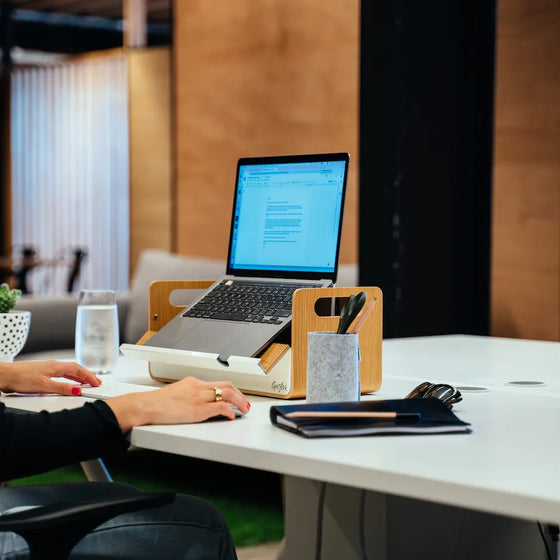
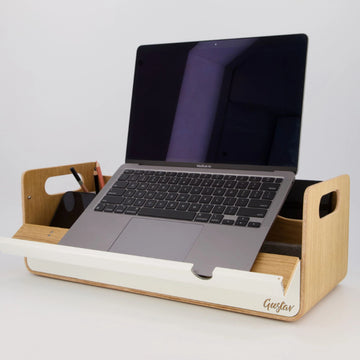
A portable desk organiser is often the starting point. It gives users one place for cables, stationery, chargers, notebooks and daily essentials. That sounds simple, but it changes the speed of setup dramatically. Instead of rebuilding a workstation from a laptop bag each morning, users place one organiser on the desk and begin. In desk-sharing environments, this also supports tidiness at the end of the day.
Laptop stands are equally important. Many hybrid workers spend too much time working directly from a laptop at the wrong height, particularly in touchdown areas and home offices. A portable stand improves screen position immediately and creates a more consistent ergonomic baseline. It does not replace every need for a full monitor setup, but it is one of the fastest ways to improve comfort in flexible working conditions.
Desk mats can look secondary, yet they do a great deal of work in shared environments. They define a personal work zone, protect surfaces and create a stable base for daily tools. In hot-desking offices, a desk mat also helps a space feel settled and professional within seconds. It introduces structure without adding visual noise.
Tech pouches and cable organisers deal with one of the least glamorous but most persistent workplace issues: loose accessories. Cables, adapters, mice and headsets quickly create disorder if they are not stored properly. Compact organisers keep those tools accessible while reducing the clutter that often builds up around temporary setups.
Work bags and integrated carry systems matter when employees move between more than one setting during the week. The accessory itself should not just store items. It should support a complete routine, from commuting to desk setup to end-of-day pack down. That is especially relevant for hybrid staff who need to carry a workday, not just a laptop.
Why the right setup matters for employers as well as users
For workplace leaders, activity-based working accessories are not only personal productivity tools. They are part of the infrastructure behind flexible work. If an organisation expects employees to move fluidly between zones, desks and locations, then basic setup quality cannot be left to chance.
There is a direct link between employee experience and the tools provided around the desk. When people can set up quickly, work comfortably and leave a space cleanly, flexible environments feel more credible. When they cannot, the office starts to create daily friction. That friction shows up in complaints about desk sharing, inconsistent ergonomics and the feeling that no workspace is ever fully ready.
This is where premium accessories often outperform cheaper alternatives. The difference is not only aesthetic. Better materials, more thoughtful dimensions and stronger craftsmanship tend to produce items that are easier to carry, nicer to use and durable enough for regular movement. For B2B buyers, durability matters because accessories in flexible workplaces are handled often, moved frequently and expected to last.
There is also a sustainability question. Disposable, low-quality desk tools rarely fit long-term workplace strategies. Accessories made from responsibly sourced materials and designed for years of use support both environmental goals and procurement standards. In many European workplaces, that is no longer a bonus. It is part of the brief.
Choosing activity-based working accessories with purpose
The right choice depends on the work model. A consultant moving between client sites needs different support from an employee using two office days and three home days each week. A design studio may prioritise portability and visual order, while a larger corporate office may focus on standardisation across shared desks.
That said, the selection process should begin with behaviour, not product categories. Look at how people actually move through the week. Do they carry equipment daily? Do they switch between focused work and meetings several times a day? Are desks fully equipped, or do users need to bring their own essentials? The answers shape what accessories will deliver real value.
It also helps to think in systems rather than single items. A laptop stand on its own can improve posture, but paired with an organiser and tech pouch it becomes part of a setup that is faster, cleaner and more repeatable. The strongest accessory choices work together to create a complete mobile workstation.
Design quality should not be treated as separate from functionality. In activity-based environments, people are repeatedly setting up in visible spaces - open offices, meeting areas, coworking lounges and home backgrounds on video calls. Accessories need to perform well, but they also need to look considered. That is one reason refined materials and understated forms have become more relevant in modern workplace design. They support professional use without making the desk feel over-equipped.
Common mistakes in flexible workspace accessory planning
One common mistake is assuming that a locker and a laptop are enough. Storage helps, but it does not create a workable desk setup. Employees still need structure on the surface, support for their device and a reliable way to carry daily tools.
Another mistake is choosing accessories purely on price. Lower-cost items may appear efficient at procurement stage, but they often wear quickly, feel awkward to use or fail to fit the visual standard of the wider workplace. In premium offices especially, poor accessory choices are noticed.
A third issue is overcomplicating the setup. Too many components can defeat the point of mobility. The aim is not to recreate a fixed workstation in bag form. It is to provide a small number of high-performing tools that make any suitable desk work better.
For this reason, the best setups tend to be restrained. One well-made organiser, one portable ergonomic tool, one clean carry solution and thoughtful cable management will often do more than a collection of miscellaneous add-ons.
A better standard for mobile work
Activity-based working accessories are often treated as finishing touches, when in reality they shape how flexible work feels day to day. They influence whether a workspace is calm or chaotic, whether a shared desk is convenient or frustrating, and whether mobility supports performance or simply adds effort.
For organisations designing better hybrid environments, and for professionals building a more consistent setup across locations, the goal is straightforward: choose accessories that make work easier to start, easier to sustain and easier to pack away. When that is done well, flexibility stops feeling improvised and starts feeling designed.
The strongest workplaces are not defined only by furniture plans or policy language. They are defined by the small tools people rely on every day, and whether those tools are good enough to carry the standard of work with them.