Choosing an Office Organiser for Commuters

A rushed train connection, a laptop balanced on a café table, then a hot desk with unfamiliar cables: commuting changes the shape of the working day. The right office organiser for commuters turns those transitions into a repeatable routine. Rather than carrying a loose collection of devices, stationery and chargers, you arrive with the tools to create a considered workspace in minutes.
That matters to more than individual comfort. In desk-sharing offices, a portable organiser supports clean desk policies without asking people to compromise on the equipment that helps them do good work. It gives each employee a personal, professional base that travels between home, office and third spaces.
What an Office Organiser for Commuters Needs to Do
A commuter organiser is not simply a storage pouch with compartments. It has to work in motion and at the desk. The difference is practical: it should protect and contain essentials during the journey, then make them accessible without spreading clutter across a shared surface.
The best designs create a clear sequence. Put the organiser down, open it, position your laptop, connect power and begin. There should be no searching through a bag for an adaptor, no cable tangled around a notebook and no need to claim more desk space than necessary. This is especially valuable when the first meeting starts ten minutes after arrival.
It should also establish a visual sense of order. A calm desk is easier to use, easier to reset and more welcoming for the next person. For organisations planning agile workplaces, this small detail can have an outsized effect on how consistently shared spaces are used.
Portability is about more than a handle
A portable organiser must feel appropriate across the whole journey. That means a profile that fits comfortably inside a work bag or can be carried as one purposeful item, without adding needless bulk. Weight matters, but so does balance. A design that is light yet awkward to carry will be left behind; one that protects essentials while remaining easy to move becomes part of the everyday kit.
Consider the last few metres of a commute as well as the train journey. Can it be carried alongside a coffee, access pass or umbrella? Does it stay composed when moved from a locker to a desk? These are modest tests, but they reveal whether a product has been designed for real workplace movement rather than static storage.
Organisation should be visible and deliberate
Hidden storage can look tidy until you need a particular cable. For commuters, the most useful organisation makes daily tools easy to recognise at a glance. A dedicated place for a charger, mouse, notebook, pens, headphones and access card reduces friction at both ends of the day.
There is a trade-off. Too many narrow compartments can make an organiser rigid and restrictive, particularly if your equipment changes between projects. Too little structure turns it into another bag within a bag. Look for intelligent zones that keep core items in place while allowing room for the larger, less predictable objects of modern work.
A well-designed layout also helps users pack consistently. When every item has a natural home, it is easier to notice that the USB-C charger or presentation clicker has been left on a desk before the journey home.
Build a Setup, Not Just a Carrying System
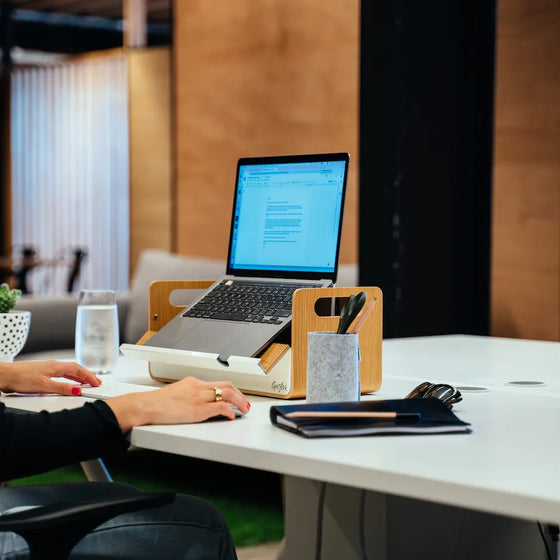
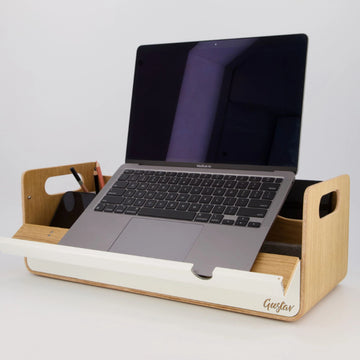
The strongest portable workspace accessories do more than hold equipment. They help create a working position that feels familiar wherever you sit. For laptop-based work, this may mean integrating a stand that raises the screen to a more comfortable viewing height, alongside space for a separate keyboard and mouse where appropriate.
Ergonomics should be approached honestly. A compact commuter setup cannot replicate every benefit of a fully equipped permanent workstation, and it does not need to. Its purpose is to improve the conditions within the space available. Raising a laptop screen, creating room for an input device and preventing the desk from becoming a cable pile can make a meaningful difference over a full day.
The desk itself affects the choice. If your office provides monitors and docking points at every desk, the organiser may only need to carry personal technology and writing tools. If employees regularly work from touchdown spaces, client sites or home dining tables, a more integrated setup becomes more valuable. Choose for the least predictable location, not only the best-equipped one.
Materials should earn their place
Premium materials are not merely an aesthetic decision when an item is used every day. They influence how the organiser feels to carry, how it wears, how easily it can be kept clean and whether it continues to look appropriate in a client meeting after months of commuting.
For design-conscious organisations and individuals, sustainably grown wood and recycled materials can bring warmth and material integrity to an otherwise technical setup. The key is durability alongside appearance. Edges, closures and surfaces are touched repeatedly, placed on varied desks and transported through busy stations. Thoughtful craftsmanship should be evident where the product works hardest.
A neutral, refined finish also has a practical advantage in shared offices: it complements different interior schemes rather than competing with them. The organiser becomes a personal work tool, not a distraction on the desk.
Choosing the Right Size for Your Commute
Start with what you genuinely carry on a typical working day, rather than everything you might use once a month. Most commuters need a laptop, charging cable, mouse, headphones, notebook, pen and a small selection of adaptors. Others may need a keyboard, external drive, drawing tools or presentation equipment.
Lay these items out before choosing a format. This quickly shows whether a slim organiser is sufficient or whether you need a more substantial workstation solution. It also exposes duplication. Carrying three charging cables because none has a designated place is a common symptom of an unplanned mobile setup.
A compact format is ideal for people who commute lightly and work mostly from well-equipped desks. It reduces bag weight and keeps personal essentials together. A larger organiser makes sense for employees moving between varied environments, particularly when their laptop is the primary screen and their desk equipment needs to travel with them.
Do not confuse capacity with usefulness. An oversized organiser invites unnecessary items and can make a short commute feel more cumbersome. The right size leaves enough room for daily essentials, protects them properly and still makes setup feel quick.
Make It Work in a Desk-Sharing Environment
For workplace teams, consistency is often more useful than an assortment of individual solutions. When employees use a common type of portable desk organiser, the arrival and departure routine becomes intuitive. People know where to place personal belongings, how to keep shared desks clear and how to reset the space at the end of the day.
This does not mean every user needs the same contents. A consultant may prioritise cables and a notebook; a designer may carry a mouse, sketchbook and specialist adaptors. The organiser should provide a common framework while allowing personal work patterns to remain intact.
Office planners should consider storage alongside desk use. Lockers, shelves and personal storage points need dimensions that accommodate mobile work tools. A beautiful organiser that has nowhere sensible to go between visits creates a new operational problem. Equally, check how it works with the office’s existing power access, monitor arms and cable management.
At Gustav, portable organisers are designed around this complete moment: carry your essentials, place them with purpose and make a desk feel ready for work. That perspective is useful whether you are selecting one personal tool or specifying a system for a larger hybrid workplace.
A Simple Test Before You Choose
Before committing, imagine the first fifteen minutes of a normal workday. You have arrived during a busy period, the available desk is not the one you used last week and you need to join a call soon. Can the organiser be carried easily, opened neatly and returned to a bag without leaving anything behind?
Then test the end of the day. Does every item have an obvious place? Can you clear the desk in under a minute, leaving it ready for the next colleague? If the answer is yes, the product is doing more than organising objects. It is supporting a better rhythm for flexible work.
A well-chosen organiser makes commuting feel less like transporting office clutter and more like carrying a workspace that is ready when you are.